


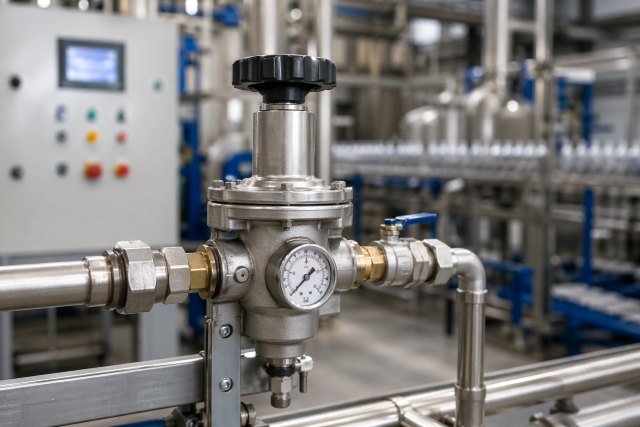
A regulator is a control device designed to keep an operating condition stable even when the input or demand changes. In practical terms, that condition might be voltage in an electronic circuit, pressure in a gas line, or another continuously changing process variable in industrial control systems. Texas Instruments describes a voltage regulator as circuitry that continuously holds output voltage at its design value despite changes in input voltage or load, while Emerson describes a pressure regulator as a device that reduces higher upstream pressure to a lower, stable working pressure and maintains it within acceptable limits as conditions vary.
- What Is a Regulator?
- How a Regulator Works
- Main Types of Regulators
- Where Regulators Are Used
- Why Regulators Matter So Much
- Real-World Example: A Regulator in Electronics
- Real-World Example: A Regulator in Gas Service
- How to Choose the Right Regulator
- Common Mistakes to Avoid
- Final Thoughts on Regulator Applications
That basic idea is what makes the word “regulator” so important across industries. Whether it is inside a smartphone charger, mounted near a gas meter outside a home, or used in a factory air line, the regulator’s job is the same at a high level: sense change, compare it with a target, and adjust output to bring the system back toward the set point. NIST also describes process controllers as devices that control continuously varying quantities such as temperature or pressure using a feedback loop, which aligns closely with how many regulators operate in the real world.
What Is a Regulator?
A regulator is not just a valve or a chip. It is better understood as a stabilizing mechanism. In electronics, it keeps voltage within a range that connected components can safely use. In fluid or gas systems, it keeps downstream pressure steady even when upstream pressure or demand changes. That stability matters because equipment is usually designed to work best within a narrow operating window. When the supplied condition drifts too far, performance can drop, efficiency can suffer, and safety risks can rise.
A good regulator does not simply block or pass flow blindly. It responds dynamically. Emerson’s pressure-regulator material explains that an ideal regulator supplies downstream demand while holding pressure constant, although real devices can show some deviation. TI’s regulator guide explains the electronic version similarly: the regulator keeps output at the desired value as long as the circuit operates within its specified range.
How a Regulator Works
At the core, most regulators follow a simple control logic. First, they measure the output. Second, they compare it with the desired set point. Third, they adjust a control element to reduce the difference. In electronics, that control element may be a pass transistor or switching stage. In pressure systems, it may be a valve plug or diaphragm-and-spring mechanism.
Emerson breaks direct-operated pressure regulators into three essential elements: a restricting element such as a valve, disk, or plug; a measuring element usually a diaphragm; and a loading element usually a spring. As downstream pressure changes, the diaphragm moves, and that movement changes the valve position so the regulator can pass more or less flow. In other words, pressure is being controlled by balancing forces inside the device.
Electronic regulators use the same feedback idea in another form. Monolithic Power explains that a linear regulator compares a sampled output voltage with an internal voltage reference and then adjusts the pass device resistance to keep output stable. TI describes a basic linear regulator as using a voltage-controlled current source to force a fixed voltage at the output terminal while sensing the output and correcting deviations through control circuitry.
This is why regulators are so useful: they are not static parts. They are self-correcting components. When demand goes up, they respond. When the input changes, they compensate. When the output drifts away from target, they push it back toward normal.
Main Types of Regulators
Because the word “regulator” is broad, it helps to think about it by application.
Voltage Regulators
Voltage regulators are among the most common regulators in daily life. They appear in power supplies, battery-powered electronics, automotive systems, industrial controls, telecom equipment, and computing hardware. Their main purpose is to keep the supplied voltage within a usable range for sensitive components. Monolithic Power notes that voltage regulators keep power-supply voltages within a range compatible with electronic components, and TI explains that they maintain constant DC output despite input and load changes.
There are two major types: linear regulators and switching regulators. Linear regulators are simple, dependable, and known for low noise and low ripple, but they can be inefficient because the voltage difference between input and output is dissipated as heat. Switching regulators are more efficient and can step voltage down, step it up, or do both, but they are usually more complex and can introduce more noise.
That trade-off explains why different products use different regulator designs. A small sensor board may prefer a linear regulator for cleanliness and simplicity. A laptop charger or high-efficiency embedded system may rely on switching regulation because wasted power becomes a serious thermal problem.
Pressure Regulators
Pressure regulators are widely used anywhere gases or liquids must be delivered at a controlled pressure. Emerson explains that a pressure reducing regulator takes a higher upstream pressure from a source such as a cylinder, compressor, or pump and reduces it to a lower, stable pressure suitable for the application. It also notes that the regulator controls delivery pressure rather than acting as a shut-off device.
These devices are common in residential gas service, commercial gas systems, instrument air lines, and industrial processes. Emerson specifically cites home gas service, industrial and commercial gas service, domestic gas service, and instrument air supply as typical applications for direct-operated regulators.
Pressure regulators are also closely tied to safety. OSHA requires safe handling, storage, utilization, inspection, and relief devices for compressed-gas systems, underscoring the need to use the right equipment and maintain it correctly in workplace settings. A regulator helps keep pressure under control, but the overall system still depends on proper installation, inspection, and relief protection.
Process and Control Regulators
In broader industrial language, regulators are part of process control. Systems that regulate temperature, pressure, or other continuously changing variables often use feedback loops to hold conditions near a target value. NIST’s description of process controllers reflects this wider role in industrial environments. In practice, a regulator may be mechanical, electronic, pneumatic, or digitally supervised, depending on the process.
Where Regulators Are Used
One reason the keyword Regulator has such broad search interest is that regulators show up in far more places than most people realize.
In consumer electronics, regulators sit inside chargers, motherboards, routers, televisions, game consoles, and battery-powered devices. Modern electronics depend on tightly controlled power rails, and even small voltage swings can affect performance or reliability.
In automotive systems, voltage regulators help stabilize power for electronic modules, sensors, infotainment units, and charging systems. Power regulation matters even more in vehicles because load conditions change constantly as accessories switch on and off. TI and Monolithic Power both frame regulators as essential where supply conditions and load current vary.
In homes and buildings, pressure regulators are used in gas service so appliances such as furnaces and stoves receive the flow they need while system pressure stays controlled. Emerson gives the residential gas meter example directly, noting that as appliances demand more gas, the regulator responds by delivering more flow while pressure should remain held constant.
In factories and workshops, regulators are used on compressed-air lines, gas cylinders, processing equipment, welding systems, and pneumatic tools. OSHA’s standards around compressed gases show how seriously workplaces must treat the safe use and inspection of these systems.
In laboratories and medical settings, regulators are used to manage gas delivery and controlled supply conditions. FDA materials show that certain pressure regulators for medical gases are regulated as medical devices in the United States, which reflects the importance of performance and risk control in healthcare applications.
In industrial process plants, regulators help maintain the conditions needed for stable production. That may involve pressure regulation in fluid lines, air supply regulation for instruments, or integration with larger process-control loops. Emerson explicitly includes industrial processes among typical regulator applications.
Why Regulators Matter So Much
Without a regulator, systems become vulnerable to fluctuation. In electronics, unstable voltage can create overheating, malfunction, noise, or component damage. In gas and fluid systems, uncontrolled pressure can reduce process accuracy, harm downstream equipment, or create safety issues. That is why regulator performance is usually discussed in terms such as accuracy, stability, response, efficiency, and operating range.
For voltage regulators, important design considerations include input voltage, output voltage, output current, efficiency, thermal behavior, and sometimes switching frequency or feedback voltage. For pressure regulators, engineers care about set point, upstream and downstream pressure, flow demand, droop, and relief strategy. Those metrics differ by field, but they all point to the same concern: how well the regulator maintains control when real-world conditions change.
Real-World Example: A Regulator in Electronics
Imagine a small embedded device powered by a battery. The battery voltage changes as it discharges, but the microcontroller may still need a steady lower voltage. A voltage regulator sits between the battery and the circuit, senses the output, and adjusts its control stage so the electronics keep receiving the correct level. TI describes that constant-output behavior as the fundamental job of the regulator.
If low electrical noise matters, a designer may choose a linear regulator. If battery life and heat matter more, a switching regulator may be the better choice. That is the kind of engineering trade-off hidden inside many everyday devices.
Real-World Example: A Regulator in Gas Service
Now think about a home or facility supplied with gas at higher upstream pressure. Appliances do not use that raw supply directly. A pressure regulator reduces that incoming pressure to a safer, usable downstream level and automatically responds as demand increases or decreases. Emerson’s residential service example shows exactly this behavior: when more appliances call for gas, the regulator delivers more flow while attempting to hold pressure steady.
This example also shows why a regulator is not the same thing as a shutoff device. Emerson specifically notes that a pressure regulator should not be used as a shut-off device because there is always a small amount of leakage across the seat; a downstream shut-off valve is needed when isolation is required.
How to Choose the Right Regulator
The best regulator depends on the application, not the name alone. Start by asking what variable must be controlled: voltage, pressure, flow, temperature, or something else. Then define the input conditions, required output, operating range, accuracy needs, and environmental constraints.
In electronics, one of the biggest decisions is linear vs. switching. If the circuit is sensitive to noise and the power loss is manageable, linear regulation may be attractive. If efficiency is critical or the output must be above the input or adapt across a wide input range, switching regulation is often the better fit.
In pressure systems, selection depends on upstream pressure, target downstream pressure, expected flow range, response characteristics, and safety requirements. OSHA’s rules also make it clear that safe handling and compliant system design matter alongside component choice.
Common Mistakes to Avoid
A common mistake is assuming every regulator is interchangeable. It is not. A regulator is always designed for a certain medium, range, response pattern, and level of precision. Using the wrong type can lead to poor performance or unsafe operation. Emerson’s guidance makes this especially clear in pressure systems, where a regulator, shutoff valve, and relief device each play different roles.
Another mistake is ignoring real operating conditions. A regulator may work perfectly on paper yet struggle with heat, load swings, noise limits, pressure droop, or maintenance demands. That is why manufacturer specifications and workplace standards matter so much in actual installation decisions.
Final Thoughts on Regulator Applications
The simplest way to understand a Regulator is to see it as a device that keeps a system stable when the world around it does not stay stable. In electronics, it holds voltage where components need it. In gas and fluid systems, it holds pressure where equipment can use it safely and effectively. In industrial control, it becomes part of a broader feedback system that keeps processes within acceptable limits.
That is why the regulator remains one of the most essential components in modern engineering. It is not flashy, but it quietly protects reliability, performance, efficiency, and safety across homes, vehicles, factories, labs, and digital devices. If you want to understand how many systems really work, understanding the regulator is a smart place to begin.