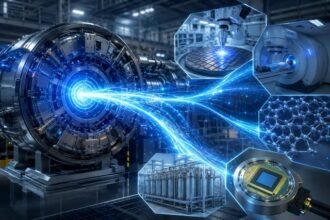


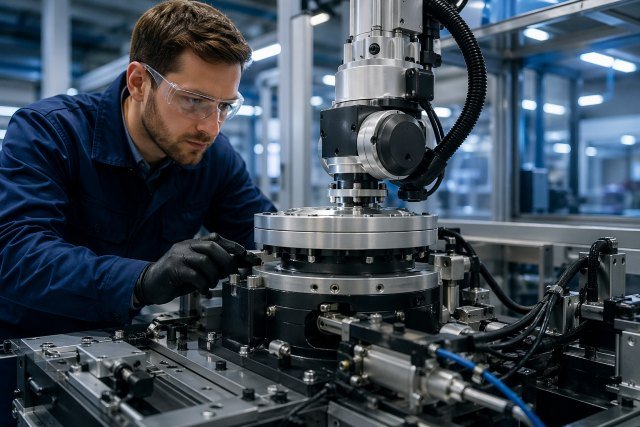
A Rotary Actuator is one of the most useful motion-control devices in modern industrial systems. Instead of creating straight-line movement like a linear actuator, it produces controlled rotational motion, usually through a limited angle such as 90°, 180°, or 360°. This makes it ideal for machines that need turning, indexing, opening, closing, positioning, clamping, or controlled torque.
- What Is a Rotary Actuator?
- Why Rotary Actuators Matter in Industrial Motion Control
- How Does a Rotary Actuator Work?
- Main Types of Rotary Actuators
- Pneumatic Rotary Actuator
- Hydraulic Rotary Actuator
- Electric Rotary Actuator
- Mechanical Rotary Actuator
- Rotary Actuator vs Linear Actuator
- Common Industrial Applications of Rotary Actuators
- Valve Automation
- Robotics and Automated Handling
- Packaging and Sorting Systems
- Material Handling
- Industrial Machinery
- Key Features to Consider Before Choosing a Rotary Actuator
- Torque Requirement
- Rotation Angle
- Speed and Cycle Time
- Position Accuracy
- Load Support
- Environment
- Control and Feedback
- Benefits of Using a Rotary Actuator
- Real-World Example: Rotary Actuator in a Bottling Line
- Real-World Example: Rotary Actuator in Valve Control
- Maintenance Tips for Rotary Actuators
- Common Mistakes to Avoid
- Rotary Actuator and Smart Manufacturing
- Frequently Asked Questions About Rotary Actuators
- What is a Rotary Actuator used for?
- What is the difference between a rotary actuator and a motor?
- Which rotary actuator is best for heavy loads?
- Are pneumatic rotary actuators accurate?
- Why is ISO 5211 important for rotary actuators?
- Conclusion: Why a Rotary Actuator Is Essential for Smart Motion Control
In simple words, a rotary actuator turns energy into movement around an axis. That energy may come from compressed air, hydraulic fluid, electricity, or mechanical force. In factories, process plants, robotics, packaging lines, material handling systems, and valve automation, rotary actuators help equipment move with speed, control, and repeatability.
What Is a Rotary Actuator?
A Rotary Actuator is a device designed to convert input energy into rotary motion or torque. This motion can be continuous, partial-turn, or position-controlled depending on the actuator type and application. A rotary actuator may use electric power, compressed air, hydraulic pressure, or mechanical components to create movement.
Unlike a standard motor that may spin continuously, many rotary actuators are designed for controlled angular movement. For example, a valve actuator may rotate exactly 90° to open or close a butterfly valve. A robotic gripper may rotate a wrist joint to a set angle. A conveyor diverter may swing a gate into position at the right moment.
This controlled rotation is what makes rotary actuators valuable in automation. They do not just “move.” They move with purpose, direction, and repeatable control.
Why Rotary Actuators Matter in Industrial Motion Control
Industrial systems depend on accurate movement. A small delay or incorrect angle can affect production quality, machine safety, or system efficiency. A rotary actuator helps solve this by delivering controlled turning motion in a compact mechanical package.
In many machines, rotary motion is more natural than linear motion. Valves need to turn. Robotic arms need to rotate. Indexing tables need angular positioning. Packaging equipment needs repeatable flipping, sorting, or guiding movements.
A well-selected rotary actuator can improve:
machine repeatability
cycle speed
torque control
equipment safety
space efficiency
automation accuracy
maintenance predictability
For industrial engineers and plant managers, this makes rotary actuators more than simple mechanical parts. They are key components in smart motion control.
How Does a Rotary Actuator Work?
A rotary actuator works by receiving energy from a source and converting that energy into rotational force. The internal mechanism depends on the actuator type.
In pneumatic rotary actuators, compressed air moves internal pistons or vanes. In a rack-and-pinion design, air pressure pushes a piston connected to a rack gear. The rack then turns a pinion gear, producing rotary output. SMC describes rack-and-pinion pneumatic rotary actuators as useful for turning, opening, closing, mixing, oscillating, and positioning tasks involving restricted rotation.
In hydraulic rotary actuators, pressurized fluid creates high torque. These actuators are common in heavy-duty equipment where compact size and strong rotational force are needed.
In electric rotary actuators, an electric motor, gear system, encoder, and control electronics work together to produce controlled angular movement. Servo-based electric rotary actuators are often chosen when accuracy, programmable motion, and feedback control are important.
Main Types of Rotary Actuators
Rotary actuators are available in several designs. Choosing the right one depends on torque, speed, angle, environment, control needs, and available power source.
Pneumatic Rotary Actuator
A pneumatic rotary actuator uses compressed air to create rotational movement. These actuators are common in manufacturing because compressed air is already available in many industrial facilities.
They are fast, compact, and reliable for repetitive tasks. Pneumatic rotary actuators are often used in pick-and-place systems, packaging machines, conveyor diverters, and valve automation.
Their main advantage is speed and simplicity. However, they may not offer the same precise positioning as electric servo actuators unless paired with sensors and advanced controls.
Hydraulic Rotary Actuator
A hydraulic rotary actuator uses pressurized oil or hydraulic fluid to generate high torque. It is often used where heavy loads, harsh environments, or high force requirements are involved.
Hydraulic rotary actuators are commonly found in construction machinery, marine systems, mining equipment, heavy industrial tools, and safety-critical mechanical systems. Some hydraulic rotary actuator manufacturers describe use cases such as valve automation, ship hatches, heavy construction machinery, aircraft testing, and rescue systems.
The biggest strength of hydraulic actuators is power density. They can produce very high torque from a relatively compact size. The drawback is that they require hydraulic infrastructure, seals, fluid management, and proper maintenance.
Electric Rotary Actuator
An electric rotary actuator uses electrical energy to generate rotational movement. These actuators may include motors, gearboxes, encoders, brakes, and control electronics.
Electric rotary actuators are ideal when precise motion control is required. They are common in robotics, medical equipment, laboratory automation, smart manufacturing, and automated inspection systems.
Their main advantage is programmability. Speed, position, acceleration, and torque can often be controlled digitally. They also avoid compressed air losses and hydraulic fluid leakage concerns.
Mechanical Rotary Actuator
Mechanical rotary actuators use gears, cams, springs, or linkage systems to create rotation. They may be manually operated or integrated into larger machines.
Although they are less flexible than electric or fluid-powered actuators, mechanical designs are still useful where simple, rugged, and low-cost movement is enough.
Rotary Actuator vs Linear Actuator
A rotary actuator creates angular motion, while a linear actuator creates straight-line motion. The best choice depends on the movement required by the machine.
A linear actuator is better when something must push, pull, lift, or slide in a straight path. A rotary actuator is better when something must turn, swing, rotate, index, open, close, or pivot.
For example, lifting a platform may require a linear actuator. Opening a quarter-turn valve requires a rotary actuator. Rotating a robotic wrist requires a rotary actuator. Sliding a gate may require a linear actuator.
In some machines, both actuator types work together. A packaging line may use linear actuators for pushing products and rotary actuators for flipping or sorting them.
Common Industrial Applications of Rotary Actuators
Rotary actuators are used across many industries because controlled rotation is needed in countless mechanical processes.
Valve Automation
One of the most common applications is valve automation. Ball valves, butterfly valves, and plug valves often require quarter-turn movement. A rotary actuator can open, close, or modulate the valve position automatically.
In valve applications, standard mounting interfaces are important. ISO 5211 specifies requirements for attaching part-turn actuators to industrial valves, helping define the interface between the actuator and valve.
This standardization makes actuator replacement, installation, and compatibility easier in industrial plants.
Robotics and Automated Handling
Rotary actuators are widely used in robotic arms, grippers, rotary joints, and positioning systems. They help machines rotate parts, change tool angles, or move components into exact positions.
In robotic handling, repeatability matters. A small angle error can affect assembly quality or cause product damage. That is why electric servo rotary actuators are often used in high-precision robotic applications.
Packaging and Sorting Systems
Packaging machines often require fast, repeatable rotation. Rotary actuators can open flaps, rotate containers, guide products, position labels, or move diverter arms.
Because packaging lines run at high speeds, actuators must be durable and consistent. Pneumatic rotary actuators are common in these systems because they are fast and simple to integrate.
Material Handling
In conveyors and material handling systems, rotary actuators can control diverters, gates, turntables, lifts, and positioning arms. They help direct products to the right lane or rotate parts before the next process.
A good rotary actuator reduces manual handling and improves workflow consistency.
Industrial Machinery
Rotary actuators are found in machine tools, welding fixtures, printing equipment, textile machinery, food processing systems, and assembly lines.
They may be used for clamping, indexing, rotating workpieces, adjusting guides, or controlling mechanical arms.
Key Features to Consider Before Choosing a Rotary Actuator
Selecting the right rotary actuator requires more than choosing a product that “turns.” The actuator must match the load, environment, control system, and duty cycle.
Torque Requirement
Torque is one of the most important selection factors. The actuator must produce enough rotational force to move the load safely and reliably.
Undersized torque can lead to stalling, slow response, overheating, or premature wear. Oversized torque may increase cost, weight, and energy use.
Engineers should consider static load, dynamic load, friction, safety factor, and any shock loads during operation.
Rotation Angle
Some rotary actuators are designed for limited angles such as 90°, 180°, or 270°. Others can rotate continuously or through multiple turns.
For valve automation, 90° is common. For indexing tables or robotic joints, a wider or programmable range may be needed.
Speed and Cycle Time
Speed matters in production environments. A faster actuator can improve throughput, but only if the machine and process can handle that speed safely.
High-speed movement may require cushioning, braking, or controlled acceleration to avoid vibration and mechanical shock.
Position Accuracy
Some applications only need open-close movement. Others require precise angular positioning.
For simple valve operation, a pneumatic actuator with end stops may be enough. For robotics or inspection systems, an electric servo actuator with encoder feedback is usually better.
Load Support
A rotary actuator may need to support radial loads, axial loads, or bending moments. If the actuator is not designed for the mechanical load, bearings and shafts can fail early.
Some industrial actuator guides focus heavily on bearing capacity, repeatability, and proper application sizing because these factors directly affect service life.
Environment
The working environment affects actuator choice. Dust, moisture, chemicals, temperature extremes, washdown areas, and explosive atmospheres all matter.
For food processing, stainless steel or corrosion-resistant designs may be preferred. For outdoor hydraulic equipment, sealing and rugged housing are critical.
Control and Feedback
Modern industrial systems often need feedback. Sensors, encoders, limit switches, and position indicators allow the control system to know where the actuator is.
This is especially important for safety systems, automated valves, robotics, and smart manufacturing lines.
Benefits of Using a Rotary Actuator
A rotary actuator offers several practical benefits for industrial systems.
First, it saves space. Since it creates rotation directly, it can often replace more complicated linkages or linear-to-rotary conversion mechanisms.
Second, it improves repeatability. A properly selected actuator can perform the same motion again and again with consistent results.
Third, it supports automation. Rotary actuators can be connected to PLCs, sensors, controllers, and industrial networks.
Fourth, it improves safety. Automated movement reduces the need for manual operation near moving machinery, hot surfaces, heavy loads, or hazardous fluids.
Finally, it can reduce downtime when selected and maintained properly. Standardized valve mounting, correct torque sizing, and predictable maintenance all support long-term reliability.
Real-World Example: Rotary Actuator in a Bottling Line
Imagine a beverage bottling plant where bottles move quickly along a conveyor. At one station, bottles must be redirected into two lanes depending on package size.
A pneumatic rotary actuator controls a small diverter arm. When a sensor detects a bottle size, the PLC sends a signal. The actuator rotates the diverter into position, guides the bottle into the correct lane, and then returns to its original position.
This movement may happen hundreds or thousands of times per hour. If the actuator is too slow, bottles may jam. If it is not repeatable, bottles may be misrouted. If it is not durable, the line may stop often.
This simple example shows why rotary actuators are important. They turn small controlled movements into big improvements in production flow.
Real-World Example: Rotary Actuator in Valve Control
In a chemical processing plant, a butterfly valve controls fluid flow through a pipe. The valve must open and close reliably based on process conditions.
A quarter-turn rotary actuator rotates the valve stem 90°. Position feedback tells the control system whether the valve is open, closed, or in an intermediate position.
In this case, reliability is critical. A failed actuator could interrupt production or create a safety risk. That is why correct torque sizing, mounting compatibility, sealing, and control feedback are essential.
Maintenance Tips for Rotary Actuators
Good maintenance can extend actuator life and reduce unexpected downtime.
Inspect seals, bearings, shafts, and mounting bolts regularly. Listen for unusual noise, vibration, or sluggish movement. Check for air leaks in pneumatic actuators and fluid leaks in hydraulic actuators.
For electric actuators, monitor motor temperature, wiring, connectors, encoder feedback, and control errors. Keep the actuator clean and protected from dust or moisture if the environment is harsh.
Also, review cycle count and duty cycle. An actuator used continuously in a high-speed production line may need more frequent inspection than one used occasionally.
The most important maintenance rule is simple: do not ignore small changes. Slower motion, inconsistent stopping, unusual sound, or increased current draw may indicate early failure.
Common Mistakes to Avoid
One common mistake is choosing a rotary actuator based only on torque. Torque matters, but it is not the only factor. Speed, duty cycle, load direction, environment, mounting style, and control requirements are also important.
Another mistake is ignoring shock loads. A machine may appear to need low torque during normal movement, but sudden stops or impacts can create much higher forces.
A third mistake is poor alignment. Misalignment between actuator and load can damage bearings, shafts, couplings, and seals.
It is also risky to use a pneumatic actuator where precise positioning is required without proper feedback and control. In that case, an electric servo rotary actuator may be more suitable.
Rotary Actuator and Smart Manufacturing
As factories become more connected, rotary actuators are becoming part of smarter motion systems. Sensors, digital controllers, predictive maintenance tools, and industrial communication networks help monitor actuator performance.
Instead of waiting for failure, operators can track cycle counts, position errors, pressure changes, torque demand, and response time. This makes maintenance more proactive.
In Industry 4.0 environments, rotary actuators are not just mechanical devices. They become data-producing components that help improve uptime, energy use, and process control.
Frequently Asked Questions About Rotary Actuators
What is a Rotary Actuator used for?
A Rotary Actuator is used to create controlled rotational movement. Common uses include valve automation, robotic joints, conveyor diverters, packaging machines, indexing systems, clamping tools, and industrial positioning equipment.
What is the difference between a rotary actuator and a motor?
A motor usually provides continuous rotation, while a rotary actuator often provides controlled angular motion, torque, or limited-position rotation. Some electric rotary actuators include motors, gearboxes, encoders, and control systems to achieve precise movement.
Which rotary actuator is best for heavy loads?
Hydraulic rotary actuators are often best for heavy loads because they provide high torque in a compact size. However, the right choice depends on torque, rotation angle, duty cycle, environment, and control requirements.
Are pneumatic rotary actuators accurate?
Pneumatic rotary actuators are repeatable for many open-close and indexing tasks, but they may not provide the same positioning accuracy as electric servo actuators. Sensors, stops, and control valves can improve performance.
Why is ISO 5211 important for rotary actuators?
ISO 5211 is important because it standardizes the attachment interface between part-turn actuators and industrial valves. This helps improve compatibility, installation efficiency, and actuator replacement in valve automation.
Conclusion: Why a Rotary Actuator Is Essential for Smart Motion Control
A Rotary Actuator is a powerful solution for industrial systems that need controlled turning motion. From valve automation and robotics to packaging, sorting, and heavy machinery, it helps machines move with accuracy, force, and repeatability.
The best actuator is not always the strongest or most expensive one. It is the one that matches the application. Torque, speed, rotation angle, duty cycle, control feedback, mounting, and environment must all be considered.
As industrial automation continues to grow, rotary actuators will remain essential for smart motion control. They make machines faster, safer, more compact, and more reliable. For any system that needs precise rotational movement, the rotary actuator is a component worth choosing carefully.