


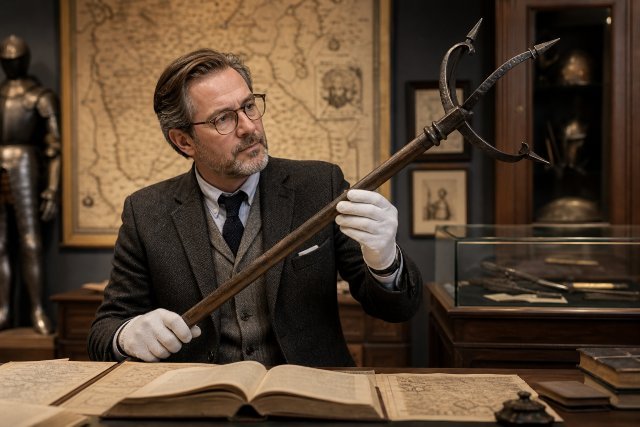
A Mancatcher is a historical pole-mounted restraint tool designed to capture, hold, or control a person from a distance. Unlike swords, spears, or axes, the Mancatcher was not mainly created to kill. Its purpose was to restrain, disable, or capture someone alive, often by trapping the body, neck, arms, or limbs with a forked or ring-like metal head.
- Mancatcher Meaning: A Simple Definition
- The Origins of the Mancatcher
- Why Was the Mancatcher Created?
- How the Mancatcher Worked
- Mancatcher Design and Key Features
- Mancatcher vs. Catchpole: Are They the Same?
- Historical Uses of the Mancatcher
- Mancatcher in Europe
- Mancatcher and the Japanese Sasumata
- Modern Relevance of the Mancatcher
- Is a Mancatcher a Non-Lethal Weapon?
- Mancatcher in Museums and Collecting
- Why People Search for Mancatcher Today
- Real-World Lessons from the Mancatcher
- Actionable Tips for Writers, Students, and History Researchers
- Common Questions About Mancatcher
- What does Mancatcher mean?
- Was the Mancatcher a real weapon?
- What was the Mancatcher used for?
- Was the Mancatcher meant to kill?
- Is the Mancatcher still used today?
- Conclusion: Why the Mancatcher Still Matters
The Mancatcher is also known by related names such as man catcher, catchpole, catch-pole, and sometimes compared with the Japanese sasumata. In simple terms, it was a long-handled control weapon used in certain military, policing, prison, and security situations.
Historical examples show that mancatchers usually had a wooden shaft with a metal head shaped like a semicircle, fork, or hinged collar. Some versions had spikes or spring-loaded parts, which made them intimidating and potentially dangerous. The Science Museum Group describes one German example from 1601–1800 as a heavy spiked metal collar with a hinged mouth on a long wooden pole.
Today, the Mancatcher is mostly studied as a historical object. It appears in museums, arms-and-armor collections, martial history discussions, and conversations about non-lethal restraint tools.
Mancatcher Meaning: A Simple Definition
A Mancatcher is a long polearm with a metal catching head used to restrain a person from a safer distance. The head was usually shaped to fit around part of the body, allowing the user to push, pin, or control the target without coming too close.
Unlike many medieval or early modern weapons, the Mancatcher had a very specific role. It was about capture rather than direct killing. This made it useful in situations where someone needed to be taken alive, controlled during arrest, removed from a horse, or held until others could secure them.
A simple featured-snippet definition would be:
A Mancatcher is a historical polearm designed to capture or restrain a person alive by using a forked, ring-shaped, or hinged metal head attached to a long wooden shaft.
This makes it different from common battlefield weapons. A spear was meant to pierce. A sword was meant to cut. A Mancatcher was meant to control movement.
The Origins of the Mancatcher
The exact origin of the Mancatcher is difficult to reduce to one country or date because similar restraint tools appeared in different cultures. However, European mancatchers are strongly associated with the late medieval and early modern periods, especially from around the Renaissance into the 18th century.
Museum records confirm surviving examples from Europe. The Science Museum Group lists a German man catcher dated between 1601 and 1800, showing that the tool was known in early modern Europe.
The Metropolitan Museum of Art also holds Japanese shafted weapons from the 19th century, showing how pole-based control tools existed beyond Europe as part of broader arms-and-armor traditions.
The Mancatcher’s development reflects a practical need: sometimes authorities or soldiers needed to stop someone without immediately killing them. This could matter when capturing criminals, prisoners, enemy soldiers, or valuable opponents who might later be questioned, imprisoned, or ransomed.
Why Was the Mancatcher Created?
The Mancatcher was created because close-contact arrest or capture was dangerous. Before modern tools like handcuffs, tasers, riot shields, or organized police gear, controlling a violent person required strength, numbers, and risk.
A long pole gave distance. A metal catching head gave leverage. Together, they allowed a person to be restrained while reducing the chance of being struck, grabbed, or stabbed.
In battlefield situations, a Mancatcher could be used against armored opponents or riders. In security settings, it could help control prisoners or aggressive individuals. In policing contexts, it gave officers or guards a way to hold someone until backup arrived.
This is why the Mancatcher remains historically interesting. It shows that earlier societies were not only inventing lethal weapons. They were also experimenting with tools for capture, control, and public order.
How the Mancatcher Worked
A typical Mancatcher had two main parts: a long shaft and a catching head. The shaft gave reach. The head did the restraining.
Some heads were shaped like a wide fork. Others had a semicircular ring. More complex versions included hinged or spring-loaded sections that could close around part of the body. The Science Museum Group’s German example specifically mentions a hinged mouth and spiked collar, which suggests a design made to hold firmly once contact was made.
The user would usually aim the head toward the target’s body, neck, arm, or upper torso, then use the pole to push or pin the person against the ground, a wall, or another surface. In some cases, the Mancatcher could help pull a rider from a horse or prevent someone from charging forward.
It is important to understand that this tool was not gentle. Even though it is often described as “non-lethal,” that does not mean harmless. The metal parts, spikes, pressure, and force involved could cause serious injury, especially if used around the neck.
Mancatcher Design and Key Features
The design of a Mancatcher varied depending on region, period, and purpose. Some were simple restraint forks, while others were ornate, heavy, and frightening.
The most common features included a long wooden pole, a metal U-shaped or ring-shaped head, and sometimes spikes or hinged locking parts. These features made the tool effective at distance but also dangerous if misused.
Some museum examples look highly decorative, which suggests that certain mancatchers may also have had symbolic value. They were not just practical objects. They represented authority, control, and the power to restrain.
A Mancatcher was not something an ordinary person would casually carry. It was more likely connected to guards, authorities, military units, prison staff, or specialized security roles.
Mancatcher vs. Catchpole: Are They the Same?
The words Mancatcher and catchpole are often used closely together. In many contexts, they refer to similar or overlapping tools. Both describe pole-mounted devices used to catch or restrain a person.
However, the exact meaning can depend on the source. “Mancatcher” is the more descriptive modern term. “Catchpole” can also appear in historical discussions and may refer to tools used by authorities to seize or control people.
Historical Uses of the Mancatcher
The Mancatcher had several historical uses, depending on the context.
In warfare, it could help capture an enemy alive. This mattered because prisoners could be valuable. A noble or armored opponent might be worth more alive than dead, especially in periods when ransom was part of warfare.
In law enforcement or guard duty, the Mancatcher could help restrain prisoners, fugitives, or violent individuals. A guard with a long pole could keep distance while controlling movement.
In mounted combat, some mancatchers may have been used to pull or control riders. A pole tool with a catching head could disrupt someone on horseback, especially when used by trained personnel.
In prison or crowd-control settings, the Mancatcher may have helped contain dangerous people without requiring immediate close physical contact.
The key theme is control. The Mancatcher was a tool of capture, restraint, and authority.
Mancatcher in Europe
European mancatchers are among the best-known examples. They are often associated with the late medieval, Renaissance, and early modern periods.
A German man catcher dated from 1601–1800 is recorded by the Science Museum Group, which helps confirm the object’s historical presence in Europe.
European designs could be severe. Some had spikes, collars, and hinged mechanisms. These features made the Mancatcher visually memorable but also potentially brutal.
In Europe, the Mancatcher fits into a wider family of polearms. Polearms were popular because they gave reach, leverage, and control. While many polearms were made for killing or battlefield dominance, the Mancatcher’s role was more specialized.
It was not a general-purpose weapon. It was a tool for a specific situation: stopping and holding a person.
Mancatcher and the Japanese Sasumata
The Japanese sasumata is often compared to the Mancatcher because it also uses a long pole with a forked end to restrain someone. Historically, the sasumata was part of Japanese arresting tools used by law-enforcement authorities.
Modern sasumata are still discussed today because some Japanese schools and businesses keep versions as emergency restraint tools. Contemporary versions are usually made with safer materials, such as aluminum and padded or blunt ends, rather than sharp historical spikes.
This comparison helps show that the idea behind the Mancatcher was not limited to Europe. Different societies developed tools that allowed people to restrain a threat at a distance.
The shared principle is simple: distance reduces danger. A pole-based restraint device gives the defender more space and time.
Modern Relevance of the Mancatcher
The Mancatcher is no longer a common Western law-enforcement tool, but its concept still has modern relevance.
First, it matters in museums and historical education. Mancatchers help people understand how earlier societies handled security, punishment, warfare, and public order. They show the complicated line between non-lethal control and physical violence.
Second, the Mancatcher is relevant to discussions about restraint technology. Modern societies still search for safer ways to stop dangerous people without using lethal force. While a historical Mancatcher is not suitable for modern civilian use, the idea of distance-based restraint still appears in some specialized tools.
Third, the Mancatcher appears in pop culture, fantasy games, historical fiction, and medieval weapon discussions. Because of its unusual design, it captures attention quickly.
During the COVID-19 pandemic, NPR reported that police in Chandigarh, India tested a device called a “social distancing clamp” or “lockdown-breaker catcher,” showing how old restraint concepts can reappear in modern forms under unusual circumstances.
Is a Mancatcher a Non-Lethal Weapon?
The Mancatcher is often called non-lethal because it was designed to capture rather than kill. However, “non-lethal” does not mean safe.
A metal collar or fork used with force could injure the neck, ribs, arms, or joints. Spiked versions were especially dangerous. If a person fell, struggled, or was pinned incorrectly, the risk of serious harm increased.
A more accurate description is:
The Mancatcher was a capture-focused historical weapon, not a harmless tool.
This distinction is important for responsible writing. It helps readers understand the object without romanticizing it.
Mancatcher in Museums and Collecting
Today, Mancatchers are mainly found in museum collections, arms-and-armor studies, antique weapon discussions, and historical exhibitions.
Museums preserve these objects because they reveal how people once thought about security and control. A Mancatcher is not just a strange weapon. It is evidence of legal systems, military priorities, prison practices, and social fear.
The Science Museum Group’s catalog entry for a German man catcher is a strong example of how museums document these tools with date ranges, materials, and descriptions.
For collectors and researchers, provenance matters. Because historical weapons can be regulated, expensive, or misidentified, serious study should rely on museum records, academic books, and trusted arms-and-armor institutions rather than viral posts or unsourced images.
Why People Search for Mancatcher Today
People search for Mancatcher for several reasons.
Some are curious after seeing a strange medieval-looking weapon online. Others encounter the term in fantasy games, history videos, museum captions, or books. Some want to know whether it was real or fictional.
The answer is clear: the Mancatcher was real. Surviving museum examples confirm that similar tools existed historically.
However, many online descriptions exaggerate it. Some present it as a common medieval battlefield weapon used everywhere, which is too simple. In reality, it was a specialized restraint tool with different designs and uses across time and place.
That makes the Mancatcher more interesting, not less. It was not just a bizarre weapon. It was a practical response to a real historical problem: how to capture dangerous people while keeping distance.
Real-World Lessons from the Mancatcher
The Mancatcher teaches several useful lessons about history and technology.
First, tools reflect social needs. The Mancatcher existed because societies needed ways to control people without always killing them.
Second, “non-lethal” tools still carry ethical concerns. A device meant to restrain can still be painful, frightening, or dangerous.
Third, design changes over time. Historical mancatchers could be heavy and spiked, while modern restraint tools inspired by similar principles may use padding, lighter materials, and safer shapes.
Fourth, context matters. A museum object should not be judged only by how strange it looks. It should be understood through the world that created it.
Actionable Tips for Writers, Students, and History Researchers
When writing about the Mancatcher, avoid calling it simply a “medieval weapon” without context. A better phrase is historical restraint polearm or capture-focused pole weapon.
Use reliable sources such as museum catalogs, arms-and-armor collections, and academic books. Avoid relying only on social media posts because images of unusual weapons are often shared without accurate details.
Explain the difference between European mancatchers and similar tools like the Japanese sasumata. This helps readers understand the broader global pattern of distance-based restraint tools.
Also, avoid presenting the Mancatcher as safe or harmless. It may have been designed to capture people alive, but many versions could still cause injury.
Common Questions About Mancatcher
What does Mancatcher mean?
Mancatcher means a pole-mounted restraint tool designed to catch, hold, or control a person. It usually had a forked, ring-shaped, or hinged metal head attached to a long shaft.
Was the Mancatcher a real weapon?
Yes, the Mancatcher was real. Museum records include historical examples, such as a German man catcher dated between 1601 and 1800 in the Science Museum Group collection.
What was the Mancatcher used for?
The Mancatcher was used to restrain, capture, or control people from a distance. It may have been used in warfare, policing, prison control, and security situations.
Was the Mancatcher meant to kill?
No, its main purpose was not killing. It was designed for capture and restraint. However, it could still injure someone, especially versions with spikes or hinged metal collars.
Is the Mancatcher still used today?
Traditional mancatchers are mostly museum objects today. However, similar restraint concepts still appear in modern tools such as the Japanese sasumata and some distance-based control devices.
Conclusion: Why the Mancatcher Still Matters
The Mancatcher remains one of history’s most unusual restraint tools. It was not a typical sword, spear, or battlefield weapon. It was a specialized device created to capture, control, and restrain people from a distance.
Its meaning, origins, and uses reveal a lot about historical security, warfare, law enforcement, and public order. From European mancatchers to similar tools like the Japanese sasumata, the same idea appears again and again: people have long searched for ways to stop threats without immediately using lethal force.
Today, the Mancatcher is most relevant as a museum artifact, research subject, and reminder of how complex “non-lethal” tools can be. It was designed to capture rather than kill, but it was still a serious and potentially harmful weapon.