


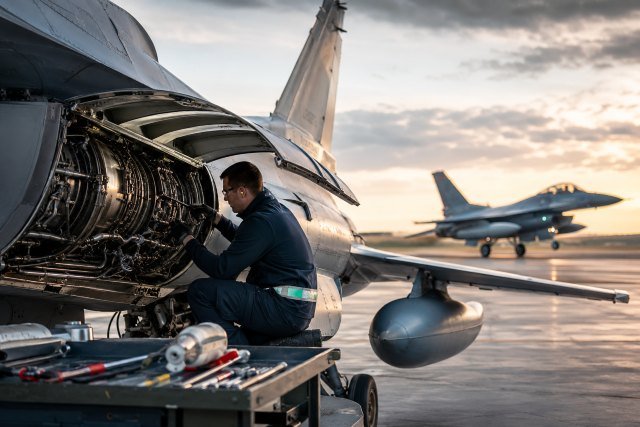
F-16 Engine Maintenance is one of the most important factors behind the fighter jet’s speed, safety, and mission success. The F-16 Fighting Falcon is known for its agility, multirole performance, and long service life, but none of that matters without a healthy engine, skilled technicians, and a disciplined maintenance culture.
- Why F-16 Engine Maintenance Matters
- F-16 Engine Maintenance and Speed Performance
- How Engine Health Supports Pilot Safety
- F-16 Engine Maintenance and Mission Success
- Key Areas of F-16 Engine Care
- Visual and Condition-Based Inspections
- Foreign Object Damage Prevention
- Engine Performance Tracking
- Documentation and Maintenance Records
- Technician Training and Human Factors
- Real-World Example: Why Small Details Matter
- F-16 Engine Maintenance and Long-Term Fleet Readiness
- Common Challenges in F-16 Engine Maintenance
- Actionable Maintenance Lessons for Aviation Teams
- FAQs About F-16 Engine Maintenance
- What is F-16 Engine Maintenance?
- Why is engine maintenance so important for the F-16?
- What engines are used in the F-16?
- How does maintenance improve mission success?
- Can poor maintenance affect aircraft safety?
- Conclusion
The F-16 is a compact, highly maneuverable multirole fighter designed for both air-to-air and air-to-surface missions, according to the U.S. Air Force’s official fact sheet. That performance depends heavily on engine reliability, because the F-16 is a single-engine aircraft. In simple terms, when the engine is well maintained, the aircraft can accelerate, climb, maneuver, and return safely with greater confidence.
Why F-16 Engine Maintenance Matters
An F-16 engine is not just a power source. It is the heart of the aircraft’s combat performance. It supports takeoff thrust, supersonic flight, quick acceleration, high-G maneuvering, fuel efficiency, and safe recovery after a mission.
Because the F-16 operates in demanding conditions, its engine faces extreme heat, pressure, vibration, airflow changes, and foreign object risks. Even small issues can affect performance if they are ignored. That is why F-16 engine inspections, scheduled servicing, fault tracking, and technician training are essential.
The F-16 fleet has used major engine families such as the Pratt & Whitney F100 and General Electric F110, both developed for high-performance military aircraft. Pratt & Whitney states that the F100 has logged more than 30 million flight hours across F-15 and F-16 fleets, while GE Aerospace describes the F110 as a proven military engine with ongoing performance and durability improvements.
F-16 Engine Maintenance and Speed Performance
Speed is one of the F-16’s strongest advantages, but speed does not come from raw thrust alone. It also depends on how consistently the engine delivers power under changing flight conditions.
A well-maintained engine helps the aircraft respond quickly when a pilot needs acceleration, climb power, or afterburner performance. In combat and training environments, delayed response or reduced thrust can affect timing, positioning, and mission effectiveness.
Maintenance teams help protect speed performance by monitoring engine condition, checking for wear, reviewing performance data, and ensuring that engine systems are operating within approved limits. This does not mean pushing the engine harder than designed. It means keeping the engine healthy enough to deliver the performance it was built to provide.
For pilots, that reliability matters. When a fighter is climbing, turning, or accelerating, the engine must respond predictably. That predictable response supports pilot confidence and tactical flexibility.
How Engine Health Supports Pilot Safety
Safety is where engine maintenance becomes even more critical. The F-16 is a single-engine fighter, so engine reliability has a direct connection to pilot safety and aircraft survivability.
Good maintenance reduces the risk of preventable failures. It also helps detect warning signs before they become serious. Aviation maintenance safety is not only about replacing parts. It is about following procedures, documenting issues, using trained judgment, and avoiding human error.
The FAA’s aviation maintenance human factors material notes that maintenance errors can include incorrectly installed parts, missing parts, and required checks not being performed. It also explains that maintenance mistakes can be difficult to detect because they may remain hidden until they affect safety.
That lesson applies strongly to military aviation. A fighter jet may look ready from the outside, but true readiness depends on careful inspection, correct servicing, accurate records, and disciplined maintenance habits.
F-16 Engine Maintenance and Mission Success
Mission success is not only about what happens in the air. It begins long before takeoff.
Before a mission, maintainers help ensure that the aircraft is ready, the engine is serviceable, and any known issues have been reviewed. After a mission, they inspect, record, and prepare the aircraft for future use. This cycle keeps the aircraft available for training, defense operations, and rapid deployment.
For an F-16 unit, engine maintenance supports mission success in three major ways:
- Readiness: More aircraft are available when maintenance is planned and managed well.
- Reliability: Pilots can focus on the mission instead of worrying about avoidable mechanical issues.
- Performance: The aircraft can deliver the speed, climb, and response expected from a fighter platform.
The F-16 remains widely used because it combines performance with long-term upgrade potential. Lockheed Martin continues to promote the F-16 as an advanced fourth-generation fighter, while the U.S. Air Force still describes it as a proven multirole weapon system. Engine sustainment is one reason aircraft like this can remain relevant for decades.
Key Areas of F-16 Engine Care
F-16 engine maintenance is highly technical and must be performed by qualified personnel using approved manuals, tools, and safety procedures. From a high-level perspective, the most important areas include inspection, cleanliness, performance monitoring, documentation, and training.
Visual and Condition-Based Inspections
Routine inspections help identify damage, leaks, loose hardware, wear patterns, corrosion, or signs of overheating. These checks are not casual walkarounds. They are structured maintenance actions designed to catch issues early.
Condition-based monitoring also helps teams make smarter decisions. Instead of only reacting to failures, maintainers can study trends and plan corrective action before an issue affects operations.
Foreign Object Damage Prevention
Foreign object damage, often called FOD, is a major concern around jet engines. Small debris can damage engine components if it enters the intake area. That is why clean workspaces, controlled tool handling, and careful ramp discipline matter.
A clean maintenance environment is not just about appearance. It directly protects engine life and aircraft safety.
Engine Performance Tracking
Modern maintenance teams rely on data. Engine performance trends can reveal changes in temperature, vibration, pressure, fuel flow, or thrust behavior. When those patterns move outside expected ranges, maintainers can investigate before the problem grows.
This approach helps reduce unexpected downtime and supports better fleet readiness.
Documentation and Maintenance Records
Accurate records are a major part of aviation maintenance. Every inspection, fault, repair, replacement, and test matters. If records are incomplete, future technicians may miss important context.
Good documentation creates continuity. It helps teams understand the aircraft’s history, identify repeated problems, and make safe decisions.
Technician Training and Human Factors
Even the best engine technology depends on people. Technicians need technical skill, focus, communication, and the confidence to stop work when something does not look right.
The FAA emphasizes that senior leadership support and human factors programs help reduce maintenance errors and improve safety culture. In an F-16 maintenance environment, that means leaders must support proper training, realistic scheduling, quality control, and clear reporting.
Real-World Example: Why Small Details Matter
Imagine an F-16 scheduled for a training sortie. The aircraft looks ready, but a technician notices an unusual sign during inspection. It may be minor. It may also be the first clue of a deeper issue.
In a strong maintenance culture, that observation is not ignored. The team reviews the issue, checks the records, follows approved guidance, and determines whether the aircraft is safe to fly. That decision may delay one sortie, but it can prevent a more serious problem later.
This is how maintenance supports mission success. It is not only about fixing broken parts. It is about making the right call before risk enters the air.
F-16 Engine Maintenance and Long-Term Fleet Readiness
Many F-16s have been flying for decades, and several air forces continue to upgrade and sustain their fleets. Long-term engine maintenance helps extend the usefulness of these aircraft.
Sustainment includes parts availability, depot-level support, inspections, modernization, and continued training. Pratt & Whitney states that the F100 remains in production and is being supported for the global F-15 and F-16 fleet, while recent reporting has also highlighted continued government investment in F100 sustainment work.
For operators, this matters because engine support is not a one-time cost. It is a long-term readiness commitment.
Common Challenges in F-16 Engine Maintenance
F-16 engine maintenance is demanding because fighter aircraft operate under stress that commercial or light aircraft do not usually experience in the same way.
Some common challenges include:
- High operating temperatures
- Afterburner-related stress
- Dust, sand, humidity, and harsh weather exposure
- Heavy training schedules
- Parts supply and depot availability
- Technician workload and fatigue
- Aging aircraft structures and systems
These challenges do not make the aircraft unsafe by default. They simply show why disciplined maintenance is essential.
Actionable Maintenance Lessons for Aviation Teams
While only certified professionals should perform F-16 maintenance, the broader lessons apply across aviation maintenance programs.
First, never treat small abnormalities as “normal” without evidence. A minor trend can become a major issue if it is ignored.
Second, protect maintenance quality from schedule pressure. Aircraft readiness is important, but rushed maintenance can create larger delays and safety risks.
Third, invest in human factors training. Many maintenance failures are not caused by lack of knowledge alone. They can come from fatigue, distraction, poor communication, or unclear procedures.
Fourth, keep records clean and consistent. Maintenance history is one of the most valuable tools for diagnosing repeated issues.
Finally, build a culture where technicians are respected. The person inspecting the engine may be the final barrier between a safe mission and an avoidable emergency.
FAQs About F-16 Engine Maintenance
What is F-16 Engine Maintenance?
F-16 Engine Maintenance is the inspection, servicing, monitoring, repair, and documentation process used to keep the fighter jet’s engine safe, reliable, and mission-ready. It includes both routine checks and deeper maintenance actions performed by qualified aviation technicians.
Why is engine maintenance so important for the F-16?
It is important because the F-16 is a single-engine fighter. Engine condition directly affects speed, climb performance, maneuverability, pilot safety, and mission readiness.
What engines are used in the F-16?
Many F-16 variants use engines from the Pratt & Whitney F100 family or the General Electric F110 family. These engines are designed for high-performance military aircraft and have been used across global fighter fleets.
How does maintenance improve mission success?
Maintenance improves mission success by reducing preventable failures, keeping aircraft available, supporting predictable engine performance, and helping pilots operate with confidence.
Can poor maintenance affect aircraft safety?
Yes. Poor maintenance can increase safety risks. Aviation maintenance errors may involve incorrect installation, missed checks, or hidden issues that remain unnoticed until they affect operations.
Conclusion
F-16 Engine Maintenance is the foundation behind the aircraft’s speed, safety, and mission success. The F-16 may be famous for its agility and combat flexibility, but its real strength depends on the people and systems that keep its engine reliable.
A healthy engine helps the aircraft accelerate, climb, maneuver, and return safely. Careful inspections reduce risk. Accurate records improve decisions. Skilled technicians protect readiness. Strong maintenance culture prevents small problems from becoming dangerous ones.
F-16 Engine Maintenance is not only a technical process. It is a mission-critical discipline that connects engineering, safety, teamwork, and operational success every time the aircraft takes flight.