

A Scheinwerfer Reinigungsanlage is a headlamp cleaning system designed to keep a vehicle’s headlights clear of dirt, road salt, slush, and grime so the light pattern stays effective and does not scatter into the eyes of other road users. In modern vehicles, this system usually works with high-pressure washer fluid, special nozzles, a pump, valves, and electronic control logic that often links headlamp cleaning to the windshield washer system when the lights are on. Dirty headlamps can reduce forward visibility and increase glare, which is why headlamp cleaning systems became especially important on powerful lighting systems such as xenon and some advanced LED setups.
- What Is a Scheinwerfer Reinigungsanlage?
- Why Modern Vehicles Use Headlamp Cleaning Systems
- How a Scheinwerfer Reinigungsanlage Works
- Main Components of a Headlamp Cleaning System
- Scheinwerfer Reinigungsanlage and Xenon or LED Headlights
- Common Problems With a Scheinwerfer Reinigungsanlage
- Maintenance Tips for Better Performance
- Do You Really Need a Scheinwerfer Reinigungsanlage?
- FAQ: Scheinwerfer Reinigungsanlage
- What does Scheinwerfer Reinigungsanlage mean?
- When does the system activate?
- Why is it important for xenon headlights?
- What are the most common faults?
- Conclusion
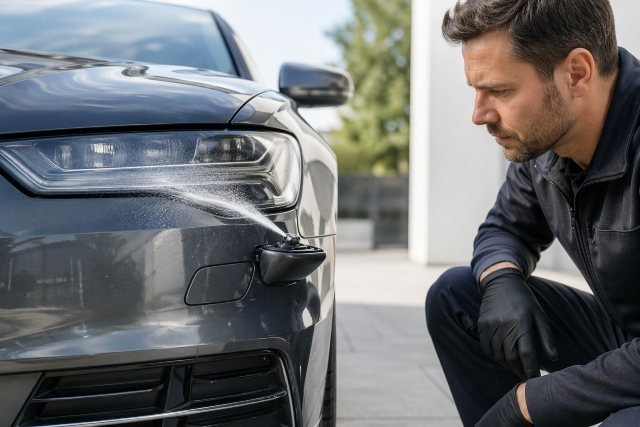
If you have ever seen small caps on a bumper that pop out briefly and spray the headlights, you have already seen a Scheinwerfer Reinigungsanlage in action. It is one of those vehicle features many drivers ignore until winter, muddy roads, or long-distance night driving make clean headlamps a real safety issue. In practical terms, the system helps preserve beam range, beam shape, and road visibility while reducing the risk of glare caused by dirt on the lens surface.
What Is a Scheinwerfer Reinigungsanlage?
A Scheinwerfer Reinigungsanlage is an automatic or semi-automatic headlight washing system. Its purpose is not cosmetic. It is a safety feature. When dirt builds up on the outer lens of the headlamp, the light can be absorbed and scattered. That means the road ahead may look dimmer to the driver, while other road users may experience more glare. HELLA’s technical guidance explains this clearly: clean headlamps provide maximum visibility and less glare, while dirty ones reduce visibility and increase dazzling effects.
In Europe, headlamp cleaning systems are also tied to regulations. UN Regulation No. 45 governs the approval of headlamp cleaners, and UN Regulation No. 48 links installation requirements to certain vehicle lighting systems. In practice, this is why headlamp cleaning is commonly associated with high-intensity systems such as xenon and with certain advanced front-lighting systems.
Why Modern Vehicles Use Headlamp Cleaning Systems
Modern headlights are much stronger and more precise than older halogen systems. That is great for nighttime driving, but it also means the lens surface matters more. When a powerful beam shines through dirt, the debris can distort the light distribution. Instead of a clean beam pattern, you may get scattered light, reduced reach, and glare. HELLA notes that more intensive headlamps are more prone to glare from dirt build-up, which is one reason legislators require cleaning systems and automatic leveling for certain setups.
This matters most in real-world driving conditions. Think of winter highways covered in slush, rainy roads that spray grime upward, or long motorway drives where a thin film of dirt slowly dulls the headlights. In those situations, even premium headlights cannot perform as intended if the outer lens is dirty. A Scheinwerfer Reinigungsanlage helps restore the lens quickly without the driver having to stop and wipe it manually.
How a Scheinwerfer Reinigungsanlage Works
Most modern headlamp cleaning systems work with a water-jet principle rather than the older wiper-style design. According to HELLA, the system usually includes whirl chamber nozzles, a water reservoir with a centrifugal pump, switching or central valves, hose assemblies, and an electronic timer or relay. Some vehicles use fixed nozzles, while others use telescopic nozzles that extend outward from the bumper when activated.
The operating sequence is fairly smart. When the driver activates the windshield washers, the headlamp cleaning system may also engage, but usually only when the lights are switched on. The pump sends washer fluid under pressure into the cleaning mechanism. In telescopic systems, pressure pushes the nozzle assembly outward against a spring until it reaches working position. A valve delays the spray until the nozzle is fully extended. Then the fluid is sprayed over the headlamp lens in cone-shaped micro-droplets that loosen and wash away dirt. Once the pump stops, the spring retracts the nozzle back into the bumper. HELLA states that one wash impulse typically lasts about 0.5 seconds for stationary nozzles and about 0.8 seconds for telescopic systems.
This design is efficient because it uses pressure, droplet shape, and timing rather than long spray cycles. The cone-shaped droplets created by whirl chamber nozzles are intended to strike the lens with enough force to break up grime while using fluid economically. That is why the system often looks brief from the outside but still does meaningful cleaning.
Main Components of a Headlamp Cleaning System
Although designs vary by manufacturer, the core parts are similar across many vehicles. The washer fluid reservoir stores the cleaning liquid. The centrifugal pump creates the pressure needed to move the fluid through the system. Hoses and valves control flow direction and timing. The nozzles shape the spray. The timer or control unit decides when cleaning should happen. In telescopic systems, an extending piston and spring mechanism moves the nozzle head into position before spraying begins.
From a driver’s point of view, this whole process is nearly invisible. From an engineering point of view, it is carefully calibrated. The system must spray the correct part of the headlamp lens, use enough pressure, and retract reliably in all weather conditions. UN Regulation No. 45 exists precisely because cleaner performance has to be measured and approved, not guessed.
Scheinwerfer Reinigungsanlage and Xenon or LED Headlights
A lot of people associate headlamp cleaning systems with xenon headlights, and that association is largely correct. Technical guidance from HELLA notes that in Europe, legal xenon retrofits require complete type-approved systems that include automatic headlamp leveling and a headlamp cleaning system. The reason is safety: strong light sources can cause serious glare when the beam is poorly controlled or the lens surface is contaminated.
For advanced LED systems, the situation can vary by vehicle type and regulatory setup, but the same basic principle applies. More powerful and more precisely controlled lighting systems benefit from lens cleanliness because dirt interferes with their beam pattern. That is why headlamp cleaning remains relevant in modern vehicle design even as lighting technology evolves.
Common Problems With a Scheinwerfer Reinigungsanlage
Like any vehicle system, headlamp washers can fail. HELLA lists common causes such as a faulty centrifugal pump, leaking hoses, blocked or defective valves, blocked nozzles, and damaged telescopic arms. If the system activates but the spray is weak or uneven, the issue may be pressure loss, blockage, or incorrect pump operation. If nothing happens at all, the cause may be electrical, such as a fuse or power supply issue.
Cold weather can also make problems more noticeable. If the fluid mix is wrong, performance may drop, and some cleaning agents can create too much foam. HELLA warns that over-dosing washer additives can cause heavy foam formation, which may stick to the headlamp and interfere with light distribution instead of improving it.
Maintenance Tips for Better Performance
A Scheinwerfer Reinigungsanlage works best when drivers use the correct washer fluid and keep the system maintained. It is a bad idea to pour in aggressive chemicals or random cleaners. HELLA advises checking the vehicle handbook before adding cleaning agents or antifreeze because the wrong chemical can damage plastic cover lenses.
It also helps to pay attention to real symptoms. If washer fluid disappears quickly, there may be a leak. If one side sprays poorly, a nozzle may be blocked. If the bumper caps do not retract properly, a telescopic mechanism may be sticking or damaged. These are not just convenience issues. Because headlamp cleanliness affects beam performance, unresolved problems can become safety problems during nighttime driving.
A practical example is winter motorway driving. A vehicle with dirty headlamps may appear to have working lights, but the beam can be scattered and shortened. A functioning cleaning system can restore much of the intended performance in seconds. That makes it especially useful for drivers in regions with snow, salt, rain, or muddy rural roads. This is one reason the feature remains relevant even when some buyers think it is just a premium extra.
Do You Really Need a Scheinwerfer Reinigungsanlage?
For older vehicles with basic halogen headlights, a headlamp cleaning system may not feel essential. But for vehicles with high-intensity lighting, it provides meaningful safety and compliance benefits. The brighter and sharper the beam, the more important it is to keep the lens clean. That is the real logic behind the system. It is not about luxury. It is about preserving light quality under dirty road conditions.
Drivers who frequently travel at night, drive in winter, or use roads with heavy spray and grime will notice the value more quickly than city-only drivers. In those conditions, being able to clean headlamps automatically without stopping can make driving more comfortable and safer.
FAQ: Scheinwerfer Reinigungsanlage
What does Scheinwerfer Reinigungsanlage mean?
It is the German term for a headlamp cleaning system or headlight washer system. It cleans the outer headlamp lens using washer fluid and nozzles so the headlights maintain proper visibility and beam performance.
When does the system activate?
In many vehicles, it activates together with the windshield washer system, but usually only when the headlights are switched on. The exact logic depends on the vehicle manufacturer and control settings.
Why is it important for xenon headlights?
Because strong light sources are more sensitive to glare problems when the headlamp lens gets dirty. In Europe, legal xenon retrofit systems typically require both automatic leveling and headlamp cleaning.
What are the most common faults?
Typical issues include blocked nozzles, faulty pumps, leaking hoses, defective valves, damaged telescopic arms, and electrical supply problems such as a blown fuse.
Conclusion
A Scheinwerfer Reinigungsanlage is a small but important part of modern vehicle safety. It keeps headlamp lenses clean, supports proper beam distribution, reduces glare risk, and helps powerful lighting systems perform the way they were designed to perform. In modern vehicles, the system usually works through a combination of washer fluid pressure, timed control logic, and precision nozzles that clean the lenses in a quick, efficient spray cycle. For drivers dealing with rain, snow, dirt, and night travel, a well-functioning Scheinwerfer Reinigungsanlage is not just a convenience feature. It is a real visibility and safety advantage.