


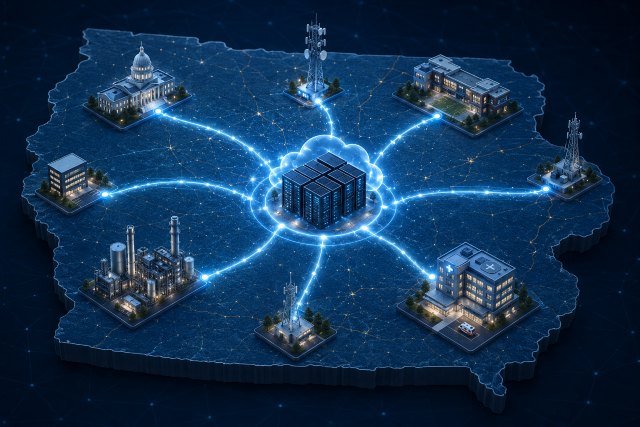
A State Wide Area Network is a secure communication backbone that connects government offices, departments, data centers, district headquarters, and local administrative units across a state or province. In simple terms, it helps public agencies share data, voice, video, and digital services through one controlled network instead of relying on scattered, disconnected systems.
- What Is a State Wide Area Network?
- Why State Wide Area Networks Matter
- State Wide Area Network Architecture
- State Headquarters Layer
- District Headquarters Layer
- Block or Local Office Layer
- Vertical and Horizontal Connectivity
- Key Components of a State Wide Area Network
- How a State Wide Area Network Works
- Real-World Uses of State Wide Area Network
- State Wide Area Network and E-Governance
- Benefits of a State Wide Area Network
- Challenges in Building a State Wide Area Network
- Best Practices for State Wide Area Network Planning
- State Wide Area Network vs Traditional WAN
- State Wide Area Network and Cloud Integration
- Example Scenario: How SWAN Improves Citizen Services
- Future of State Wide Area Networks
- Common Questions About State Wide Area Network
- What is a State Wide Area Network?
- What is the main purpose of SWAN?
- How is a State Wide Area Network different from the internet?
- Who uses a State Wide Area Network?
- Why is SWAN important for e-governance?
- Actionable Tips for Better SWAN Implementation
- Conclusion
The concept is especially important in e-governance. Many public services now depend on fast and reliable connectivity, from digital records and online certificates to video meetings, emergency coordination, education platforms, and citizen service portals. A State Wide Area Network, often called SWAN, gives governments the infrastructure they need to deliver those services efficiently.
In India, SWAN has been recognized as a core infrastructure component for e-governance, designed to connect State Headquarters, District Headquarters, and Block Headquarters through secure connectivity. Official state-level SWAN descriptions explain that the network supports government-to-government and government-to-citizen services through a secure closed user group network.
What Is a State Wide Area Network?
A State Wide Area Network is a wide-area communication network built to connect public offices and institutions across a large geographic area within a state. It is not just a normal internet connection. It is usually planned as a managed, secure, and scalable network for government operations.
A normal wide area network, or WAN, connects local networks across large distances. Cisco defines a WAN as a collection of LANs or other networks that communicate with each other across a broad area. A State Wide Area Network applies this WAN concept to state-level governance, public administration, and digital service delivery.
For example, a state government may have offices in the capital city, district offices in several towns, block-level offices in rural areas, and service centers for citizens. Without a SWAN, each office may use separate internet lines, separate security controls, and separate communication systems. This can create slow service, weak coordination, and higher costs.
With a State Wide Area Network, these offices can be connected through a unified digital backbone. This allows departments to share records, use centralized applications, hold video conferences, access state data centers, and process citizen requests faster.
Why State Wide Area Networks Matter
State governments handle large volumes of sensitive and time-critical information. Land records, tax records, health data, education records, police communication, welfare schemes, and public service requests all need secure movement between offices.
A State Wide Area Network matters because it creates a structured digital highway for this information. Instead of depending only on public internet connections, government departments can work through a dedicated and monitored network.
This improves reliability, accountability, and service delivery. In India’s SWAN model, the goal has been to provide secure connectivity for government operations and support G2G, G2C, and related electronic transactions. Tripura’s SWAN security policy notes that SWANs support common communication infrastructure for government bodies and public sector agencies, including electronic G2G, G2B, and G2C transactions.
For citizens, the benefit is indirect but powerful. When a district office can instantly access central records, people do not need to wait weeks for basic services. When hospitals, schools, and administrative offices are connected, decisions become faster and more data-driven.
State Wide Area Network Architecture
The architecture of a State Wide Area Network usually follows a hierarchical design. This means the network is arranged in levels, from the state headquarters down to district and local offices.
In many SWAN implementations, the architecture includes three major layers: the State Headquarters, District Headquarters, and Block or Sub-Division Headquarters. Meghalaya’s official SWAN page describes this model as connecting each State or Union Territory Headquarters with District Headquarters and then connecting District Headquarters with Block Headquarters.
This layered structure is useful because it mirrors how government administration works. State-level departments sit at the top, district-level offices manage regional operations, and block-level offices handle local service delivery.
State Headquarters Layer
The State Headquarters layer is the central point of the State Wide Area Network. It usually connects to the state data center, major government departments, network operations center, internet gateway, cloud systems, and security infrastructure.
This layer handles the highest volume of traffic. It may host core routers, firewalls, identity systems, monitoring tools, video conferencing platforms, and links to national government networks.
The State Headquarters layer must be designed for high availability. If the main state network hub fails, many services across the state can be affected. That is why redundancy, backup links, disaster recovery planning, and continuous monitoring are essential.
District Headquarters Layer
The District Headquarters layer connects district-level administrative offices to the state network backbone. District offices often handle land administration, public health coordination, education records, police reporting, local taxation, and welfare service implementation.
In a well-designed State Wide Area Network, each district point of presence acts as a regional network hub. It connects local offices within the district and sends traffic upward to the State Headquarters when needed.
This design reduces communication gaps between the state capital and remote districts. It also allows the state government to deploy centralized applications while still serving users across different regions.
Block or Local Office Layer
The block, sub-division, or local office layer brings digital connectivity closer to citizens. This is where many public-facing services are delivered.
For example, a local office may help citizens apply for certificates, check welfare scheme status, access land records, pay fees, or submit forms. If the local office is connected through a State Wide Area Network, it can access official systems quickly and securely.
This layer is especially important for rural and semi-urban areas. Without reliable last-mile connectivity, digital government remains limited to major cities. A strong SWAN helps reduce that gap.
Vertical and Horizontal Connectivity
A State Wide Area Network usually has two types of connectivity: vertical and horizontal.
Vertical connectivity means the connection from the state level to the district level and then down to the block or local level. This is the backbone structure of the network.
Horizontal connectivity means connecting different government offices at the same level. For example, multiple departments in a district may connect to the district point of presence. This allows local departments to communicate with each other and with the state backbone.
This combination is important because government work is not always top-down. A district health office may need to coordinate with a district education office. A local revenue office may need to share information with a welfare department. Horizontal connectivity helps these offices work together.
Key Components of a State Wide Area Network
A State Wide Area Network includes several technical and operational components. These components work together to keep the network secure, stable, and useful.
The first major component is the point of presence, or PoP. A PoP is a physical network location where connectivity equipment is installed. It may include routers, switches, firewalls, power backup, and monitoring devices.
The second component is the communication link. This can include leased lines, fiber links, MPLS circuits, wireless links, VSAT, or other technologies depending on geography and budget. Older SWAN planning documents mention technologies such as leased circuits, VSAT, radio frequency, and Ethernet ports as possible connectivity methods.
The third component is the network operations center. This team or facility monitors uptime, bandwidth, faults, security alerts, and service quality. Without active monitoring, even a strong network can suffer from long outages.
The fourth component is security infrastructure. Firewalls, intrusion detection systems, VPNs, authentication controls, encryption, access policies, and log monitoring are essential because government networks carry sensitive information.
The fifth component is service integration. A SWAN is most valuable when it connects with state data centers, cloud services, digital identity systems, citizen service portals, and departmental applications.
How a State Wide Area Network Works
A State Wide Area Network works by creating a managed communication path between different government locations. When a user in a block office accesses a government application, the request travels through the local network, reaches the block PoP, moves to the district PoP, and then reaches the state data center or application server.
The process may sound simple, but many controls operate in the background. Routing devices decide the best path for traffic. Firewalls check whether the request is allowed. Monitoring systems track performance. Authentication systems confirm whether the user has permission.
If the network is designed properly, users experience fast and reliable service. If it is poorly designed, users may face slow applications, dropped video calls, security risks, and frequent downtime.
This is why architecture, bandwidth planning, cybersecurity, and maintenance are just as important as the physical network connection.
Real-World Uses of State Wide Area Network
A State Wide Area Network is not built only for IT departments. Its real value appears when it improves everyday government services.
One common use is digital public service delivery. Citizens may apply for certificates, licenses, permits, welfare benefits, or land records through connected service centers. The SWAN allows these service centers to communicate with official databases and departments.
Another use is video conferencing. State officials can meet with district officers without travel delays. This is useful during policy reviews, disaster response, election preparation, health campaigns, and law-and-order coordination.
A third use is centralized application access. Instead of installing separate software in every office, governments can host applications in a state data center or cloud platform. Offices across the state can then access the same system through SWAN.
A fourth use is education and training. Government schools, training institutes, and administrative academies can connect to digital classrooms, learning management systems, and online workshops.
A fifth use is healthcare coordination. District hospitals and local health offices can share reports, track public health programs, and communicate with state-level health departments.
A sixth use is disaster management. During floods, earthquakes, storms, or public emergencies, reliable connectivity helps officials coordinate relief work, share data, and communicate quickly.
State Wide Area Network and E-Governance
E-governance depends on three things: digital services, secure data, and reliable connectivity. A State Wide Area Network supports all three.
Without connectivity, digital government applications cannot reach the offices and citizens that need them. Without security, sensitive records can be exposed. Without reliability, public services become frustrating and slow.
This is why SWAN is often treated as core infrastructure rather than a small IT project. In India, SWAN has been part of a larger e-governance infrastructure approach, along with state data centers and service delivery channels. Official descriptions of SWAN emphasize its role in connecting government offices and enabling secure digital service delivery.
For example, a land record system may be hosted at the state level. Through SWAN, district and block offices can access it securely. Citizens can request copies locally instead of traveling to the state capital.
Benefits of a State Wide Area Network
The biggest benefit of a State Wide Area Network is better coordination. Departments no longer work in complete isolation. They can communicate, share data, and use common platforms.
Another benefit is faster service delivery. When offices are digitally connected, approvals, verifications, and record checks can move faster.
Security is also a major advantage. A managed government network can apply stronger access controls than random public internet connections. It can also be monitored centrally.
Cost optimization is another benefit. While building a SWAN requires investment, it can reduce duplication over time. Instead of every department buying separate systems and connections, the state can use shared infrastructure.
A State Wide Area Network also improves transparency. Digital systems create logs, reports, and audit trails. This helps governments track service delivery and identify delays.
Challenges in Building a State Wide Area Network
Building a State Wide Area Network is not easy. One major challenge is geography. States may include cities, forests, mountains, islands, remote villages, and low-connectivity regions. A single technology may not work everywhere.
Another challenge is bandwidth demand. As more departments use video, cloud applications, digital records, and real-time dashboards, older network capacity may become insufficient.
Cybersecurity is a growing challenge as well. Government networks are attractive targets because they carry valuable data and support critical services. Strong security design is not optional.
Maintenance is also difficult. Equipment must be updated, links must be tested, faults must be resolved, and service-level agreements must be monitored.
Finally, user adoption can be a challenge. A network alone does not create digital transformation. Staff need training, applications need usability, and departments need clear processes.
Best Practices for State Wide Area Network Planning
A good State Wide Area Network should begin with a clear needs assessment. Governments should identify which departments need connectivity, what applications they use, what bandwidth they require, and which locations are mission-critical.
The design should include redundancy. Important offices should not depend on a single link or single device. Backup paths and failover planning reduce downtime.
Security should be built into the architecture from the beginning. This includes role-based access, network segmentation, encryption, firewall policies, endpoint controls, and continuous monitoring.
Bandwidth should be planned for future growth, not just current usage. Video meetings, cloud applications, digital records, and AI-enabled analytics can quickly increase traffic.
Monitoring should be centralized. A network operations center should track uptime, latency, packet loss, device health, bandwidth use, and security alerts.
Governments should also review service-level agreements carefully. If a private network operator or telecom provider is involved, performance expectations must be measurable and enforceable.
State Wide Area Network vs Traditional WAN
A traditional WAN can connect any organization’s branches across different locations. A State Wide Area Network is a specialized WAN designed for government operations across a state.
The difference is mainly in purpose, scale, ownership, and security. A corporate WAN may connect offices, warehouses, and data centers for business operations. A SWAN connects public departments, district offices, local government units, and citizen service systems.
Another difference is accountability. A State Wide Area Network supports public services, so downtime can affect citizens, not just internal employees. This makes reliability and governance more important.
State Wide Area Network and Cloud Integration
Modern government networks increasingly connect with cloud infrastructure. Cloud platforms allow governments to host applications, store data, and scale services more efficiently.
In India, MeghRaj is a government cloud initiative that provides cloud service models such as Infrastructure as a Service and Platform as a Service for e-governance needs.
When a State Wide Area Network connects with cloud systems, offices across the state can access centralized digital services. This reduces the need to maintain separate servers in every location.
However, cloud integration also requires strong security. Identity management, encryption, backup planning, and compliance controls must be carefully managed.
Example Scenario: How SWAN Improves Citizen Services
Imagine a citizen in a small town needs a caste certificate, income certificate, or land record copy. In the past, the request might require physical files, manual verification, and several office visits.
With a State Wide Area Network, the local office can connect to official databases through a secure network. The officer can verify records, submit the request, and track the application digitally. The district office can review it, and the state system can update the final status.
This does not remove every administrative step, but it reduces unnecessary delays. It also gives citizens a better experience because the system becomes more connected.
Future of State Wide Area Networks
The future of State Wide Area Networks will likely include higher bandwidth, stronger cybersecurity, cloud-native applications, software-defined networking, and better last-mile connectivity.
SD-WAN may also play a larger role. Software-defined WAN can help manage traffic intelligently, improve application performance, and simplify network operations across many sites.
Another future trend is integration with digital identity, data analytics, and real-time dashboards. Governments increasingly need live information to make decisions in health, transport, education, agriculture, and disaster management.
The next generation of State Wide Area Networks will not only connect offices. It will support smarter, faster, and more citizen-focused governance.
Common Questions About State Wide Area Network
What is a State Wide Area Network?
A State Wide Area Network is a secure communication network that connects government offices, departments, data centers, district offices, and local administrative units across a state. It supports digital governance by carrying data, voice, video, and application traffic.
What is the main purpose of SWAN?
The main purpose of SWAN is to provide reliable and secure connectivity for government operations. It helps departments communicate, share data, use centralized applications, and deliver public services more efficiently.
How is a State Wide Area Network different from the internet?
The internet is a public global network. A State Wide Area Network is usually a managed and controlled network for government use. It may connect to the internet, but its core purpose is secure internal communication and service delivery.
Who uses a State Wide Area Network?
State departments, district offices, block offices, public service centers, government agencies, and sometimes public sector institutions use a State Wide Area Network.
Why is SWAN important for e-governance?
SWAN is important because e-governance services need reliable connectivity. Without a strong network, digital applications cannot reach local offices or citizens effectively.
Actionable Tips for Better SWAN Implementation
Governments planning or upgrading a State Wide Area Network should focus on reliability first. Critical offices need backup links, strong power support, and tested failover systems.
Security should be reviewed regularly. A network that was safe five years ago may not be safe today. Regular audits, patching, access reviews, and incident response drills are necessary.
User training should not be ignored. Even the best network will fail to deliver value if employees do not know how to use digital systems properly.
Performance data should guide upgrades. Instead of guessing where the network is slow, administrators should use monitoring reports to identify high-traffic links, weak locations, and recurring faults.
Finally, SWAN planning should stay citizen-focused. The goal is not only to connect government offices. The real goal is to make public services faster, more transparent, and easier to access.
Conclusion
A State Wide Area Network is one of the most important building blocks of modern digital governance. It connects state, district, and local offices through a secure and managed communication backbone. This allows governments to share data, run centralized applications, improve coordination, and deliver better services to citizens.
Its architecture usually includes state-level, district-level, and block-level connectivity, supported by points of presence, secure links, monitoring systems, and network operations. When planned well, a State Wide Area Network improves speed, reliability, transparency, and public service delivery.
As governments move toward cloud platforms, digital records, online citizen services, and real-time decision-making, the role of SWAN will become even more important. A strong State Wide Area Network is not just a technical project. It is a foundation for smarter, more connected, and more responsive governance.