

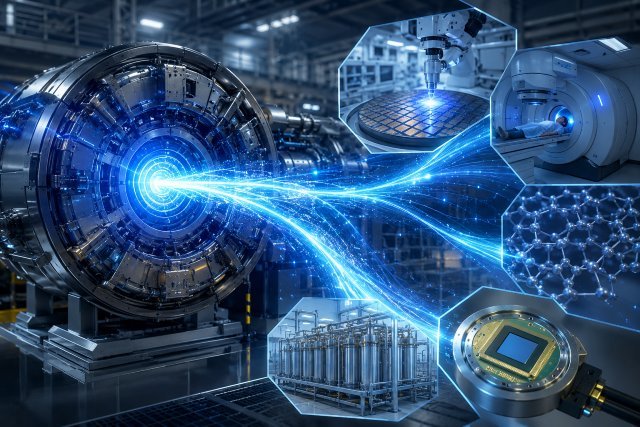
Particle Accelerator Byproduct may sound like a highly technical term, but its impact reaches far beyond physics laboratories. From medical imaging and cancer treatment to semiconductor development, advanced materials, space technology, and environmental research, the byproducts created through particle accelerator processes play a growing role in modern innovation.
- What Is a Particle Accelerator Byproduct?
- Why Particle Accelerator Byproduct Matters in Advanced Technology
- Particle Accelerator Byproduct in Medical Technology
- Particle Accelerator Byproduct in Cancer Research and Treatment
- Particle Accelerator Byproduct in Semiconductor and Electronics Testing
- Particle Accelerator Byproduct in Materials Science
- Industrial Uses of Particle Accelerator Byproduct
- Particle Accelerator Byproduct and Environmental Research
- Role in Energy and Nuclear Technology
- Real-World Example: From Physics Lab to Hospital
- Real-World Example: Testing Electronics for Space
- Benefits of Particle Accelerator Byproduct
- Challenges and Safety Concerns
- Future of Particle Accelerator Byproduct in Advanced Technology
- Actionable Tips for Businesses and Researchers
- Frequently Asked Questions
- What is a Particle Accelerator Byproduct?
- How is Particle Accelerator Byproduct used in medicine?
- Is Particle Accelerator Byproduct dangerous?
- Why are particle accelerators important for technology?
- Can particle accelerator byproducts help the environment?
- Conclusion
A particle accelerator is a machine that speeds up charged particles, such as electrons, protons, or ions, to very high energies. These fast-moving particles can collide with materials, create radiation beams, produce isotopes, alter material properties, or reveal the hidden structure of matter. The U.S. Department of Energy describes accelerators as tools that produce beams of charged particles for research and practical applications.
What makes this topic especially interesting is that many valuable outcomes are not always the main reason an accelerator is built. Some results appear as secondary outputs, transformed materials, radioactive isotopes, radiation fields, or scientific data. These are often described broadly as accelerator byproducts, and they can become extremely useful in medicine, engineering, manufacturing, and security.
In simple terms, particle accelerator byproducts are not just “leftovers.” In many cases, they are the hidden engines behind advanced technology.
What Is a Particle Accelerator Byproduct?
A Particle Accelerator Byproduct is any useful secondary result produced during or after the operation of a particle accelerator. This may include radioisotopes, radiation beams, activated materials, secondary particles, improved materials, imaging data, or new scientific knowledge.
When high-energy particles strike a target, they can trigger nuclear or atomic-level changes. These changes may produce isotopes for medical scans, radiation for sterilization, or modified surfaces for stronger industrial materials. The IAEA explains that accelerator beams can sterilize medical equipment and produce radioisotopes used in radiopharmaceuticals for cancer diagnosis and therapy.
This is why the word “byproduct” should not be seen negatively. In advanced technology, a byproduct can become a solution.
For example, a cyclotron may be used to produce radioisotopes for PET scans. A linear accelerator may generate beams for cancer treatment or industrial inspection. Research accelerators may create radiation environments that help test electronics for aerospace missions.
The main accelerator process creates energy, collisions, or beams. The byproducts help turn that process into real-world value.
Why Particle Accelerator Byproduct Matters in Advanced Technology
Modern technology increasingly depends on precision at tiny scales. We need to understand materials at the atomic level, test electronics under harsh conditions, treat disease with targeted tools, and manufacture components that are safer, cleaner, and more reliable.
Particle accelerator byproducts help make this possible.
Unlike ordinary industrial tools, accelerators can interact with matter in extremely controlled ways. They can modify a material without cutting it open, inspect internal structures without destroying the object, or create isotopes that travel inside the human body for medical imaging.
This makes accelerator technology valuable in fields where accuracy matters most.
In healthcare, accelerator byproducts support imaging, radiotherapy, and isotope production. In electronics, they help test how chips respond to radiation. In manufacturing, they support sterilization and material processing. In environmental science, ion beams help analyze pollutants and trace elements.
In other words, accelerators do not only help physicists study the universe. They also help engineers, doctors, manufacturers, and researchers solve practical problems.
Particle Accelerator Byproduct in Medical Technology
One of the most important uses of particle accelerator byproduct is in medicine. Hospitals and research centers use accelerators to produce radioisotopes, support cancer therapy, improve imaging, and develop better treatments.
Radioisotopes are radioactive forms of elements that can be used in diagnosis or therapy. In medical imaging, they help doctors see what is happening inside the body. In treatment, certain isotopes can deliver radiation directly to cancer cells.
The IAEA notes that if someone has had a PET scan or heard about radiation treatment for cancer or brain tumors, a cyclotron may have been involved. Cyclotrons produce radioisotopes by accelerating charged particles and colliding them with target materials.
This is a powerful example of how a particle accelerator byproduct becomes a medical tool. The accelerator does not simply create energy; it creates useful isotopes that can support diagnosis and treatment.
Another example is actinium-225, a radioactive isotope being studied for targeted cancer therapy. The U.S. Department of Energy explains that alpha-emitting isotopes such as Ac-225 show promise because of their short path length and high energy transfer, making them attractive for certain cancer treatment applications.
Particle accelerators also support external beam radiation therapy. Medical linear accelerators are widely used to treat cancer by directing high-energy radiation at tumors. The IAEA notes that megavoltage therapy developed with cobalt-60 machines and medical linear accelerators, while other accelerator types have also found uses in radiotherapy.
For patients, this technology can mean earlier diagnosis, more targeted treatment, and better tools for doctors. For researchers, it opens the door to new radiopharmaceuticals and advanced cancer therapies.
Particle Accelerator Byproduct in Cancer Research and Treatment
The connection between particle accelerator byproduct and cancer research is especially strong. Accelerators can produce isotopes, generate therapeutic beams, and support the study of biological structures.
The U.S. Department of Energy states that it provides cancer researchers with tools such as supercomputers, particle accelerators, isotope production facilities, and nuclear physics expertise. These tools have helped build the foundational science behind cancer research.
Particle therapy is another major area. Instead of using conventional X-rays, particle therapy can use protons or heavier ions to target tumors. These particles can deposit energy in a more controlled way, which may help reduce damage to nearby healthy tissue in certain cases.
Scientific reviews describe cancer therapy with accelerated charged particles as one of the most valuable biomedical applications of nuclear physics.
This does not mean every cancer patient needs particle therapy. Treatment depends on cancer type, stage, location, cost, access, and clinical judgment. However, it does show how accelerator science has moved from research laboratories into highly specialized medical care.
Particle Accelerator Byproduct in Semiconductor and Electronics Testing
Advanced electronics must survive extreme environments. Satellites, aircraft systems, defense electronics, nuclear facilities, and high-reliability chips may face radiation exposure that ordinary devices never experience.
Particle accelerator byproducts help test these systems before they are used in critical missions.
Accelerators can simulate radiation conditions similar to space or high-energy environments. Engineers use these tests to see whether a microchip fails, resets, degrades, or continues working under radiation stress.
This is especially important for aerospace technology. A satellite repair is not simple once the system is in orbit. Testing components on Earth with accelerator-generated radiation helps reduce risk.
CERN has also highlighted accelerator-related platforms for advanced medical treatments and aerospace electronics, showing that accelerator technology now supports multiple high-precision industries beyond particle physics itself.
For semiconductor companies, this kind of testing can improve product reliability. For space agencies and aerospace contractors, it can prevent mission failure. For consumers, it eventually supports more dependable technology in navigation, communication, and safety systems.
Particle Accelerator Byproduct in Materials Science
Materials science is another field where particle accelerator byproducts are extremely valuable. Accelerators can reveal how materials behave under stress, radiation, heat, and chemical exposure.
Ion beams can be used to study surfaces, measure contamination, and analyze the composition of materials. The IAEA explains that scientists use ion beams for tasks such as identifying pollutants, characterizing contaminants in food, imaging biological cells, and dating historical objects.
This matters because many advanced technologies depend on materials that must perform under difficult conditions.
Think about turbine blades, nuclear reactor components, battery materials, medical implants, aerospace alloys, and microelectronic devices. These materials must be strong, stable, and predictable. Accelerator-based analysis helps researchers understand tiny defects and structural changes that ordinary inspection methods might miss.
Particle accelerator byproducts can also support material modification. Electron beams and ion beams may change surface properties, improve hardness, support cross-linking in polymers, or help create specialized coatings.
This is where accelerator technology becomes part of modern manufacturing. It helps industries design materials that are not only stronger but also smarter.
Industrial Uses of Particle Accelerator Byproduct
Particle accelerator byproducts are widely used in industrial environments, especially where safety, cleanliness, and precision are important.
One major example is sterilization. Accelerator beams can sterilize medical devices without relying on traditional chemical methods. This supports hospitals, device manufacturers, and pharmaceutical supply chains.
The IAEA notes that accelerator beams can sterilize medical equipment, while accelerator-based facilities are becoming more important as demand for ionizing radiation services grows worldwide.
Industrial accelerators can also be used for:
- Treating plastics and polymers
- Inspecting welds and dense materials
- Improving cable insulation
- Supporting food safety research
- Testing components for radiation resistance
- Processing materials without direct contact
These applications show that accelerator byproducts can make industrial systems cleaner, safer, and more efficient.
For example, electron-beam processing can alter polymers in ways that improve performance. In quality control, accelerator-based imaging can inspect internal flaws without destroying the product. In sterilization, beams can treat sealed products quickly and effectively.
This is why accelerators are not only research machines. They are also industrial tools.
Particle Accelerator Byproduct and Environmental Research
Environmental science also benefits from accelerator byproducts and accelerator-based analysis.
Ion beams can help detect trace pollutants, study soil samples, identify contaminants, and analyze environmental materials. Because these techniques can detect very small quantities of elements, they are useful for pollution tracking and environmental monitoring.
This is important in a world where industries need better tools to measure contamination and improve sustainability.
For example, researchers may analyze air particles to understand pollution sources. They may examine water or soil samples for trace metals. They may study how materials degrade in harsh environmental conditions.
Accelerator-based tools can provide precise data that supports better decisions. Governments, laboratories, and environmental agencies can use this information to monitor risks and design cleaner systems.
Role in Energy and Nuclear Technology
Particle accelerator byproduct also has a role in energy research, especially nuclear science and waste management.
Accelerator-driven systems are being studied as part of advanced nuclear research. Some concepts use accelerators to generate particle beams that help drive nuclear reactions. These systems may support research into waste transmutation, safer reactor concepts, or advanced fuel cycles.
The IAEA has discussed accelerator-driven systems in relation to managing radioactive waste, including research into reducing long-term radiotoxicity.
This field is complex and still developing. It is not a simple overnight solution to nuclear waste. However, it shows how accelerator science may contribute to long-term energy challenges.
Accelerators also support fusion research, radiation damage studies, and testing of materials for future energy systems. Since advanced energy technologies often operate in extreme environments, accelerator-based testing can help researchers understand how materials and components behave before they are used in real systems.
Real-World Example: From Physics Lab to Hospital
A practical example helps explain the value of particle accelerator byproduct.
Imagine a cyclotron installed at or near a medical center. Its main job is to accelerate charged particles. When those particles hit a target material, they create radioisotopes. These isotopes are then used to prepare radiopharmaceuticals for PET imaging.
A patient receives a small amount of the radiopharmaceutical. Doctors use imaging equipment to track how it behaves inside the body. This helps reveal disease activity, organ function, or tumor behavior.
In this case, the accelerator’s byproduct becomes a diagnostic tool.
Without the accelerator, the isotope may be difficult to produce locally because many medical isotopes have short half-lives. That means they decay quickly and must be produced, transported, and used within a limited time.
This is one reason cyclotrons are so important in modern medical imaging.
Real-World Example: Testing Electronics for Space
Another example comes from aerospace electronics.
A company designing satellite components needs to know whether its chips can survive radiation in space. Instead of waiting for failure in orbit, engineers use accelerator-generated radiation to test components on Earth.
They expose the electronics to controlled radiation conditions, record failures, improve the design, and test again. The accelerator byproduct here is not a medical isotope. It is a controlled radiation environment.
That byproduct helps create safer satellites, stronger communication systems, and more reliable space missions.
Benefits of Particle Accelerator Byproduct
The biggest benefit of particle accelerator byproduct is that it turns high-energy physics into practical technology.
In healthcare, it supports imaging, cancer treatment, and radiopharmaceutical production. In industry, it improves sterilization, testing, and material processing. In electronics, it helps prepare chips for harsh environments. In environmental science, it supports highly sensitive analysis.
Another benefit is precision. Accelerators allow scientists and engineers to control energy, beam type, target material, and exposure conditions. That level of control is difficult to achieve with many conventional tools.
There is also a sustainability angle. In some cases, accelerator-based processes may reduce the need for chemical treatments or destructive testing. For example, radiation sterilization can treat sealed products, while non-destructive inspection can detect internal defects without wasting materials.
Challenges and Safety Concerns
Particle accelerator byproducts are powerful, but they also require careful control.
Radiation safety is a major concern. Facilities must follow strict rules for shielding, monitoring, worker protection, and waste handling. The IAEA emphasizes that safety services cover design, siting, engineering safety, operational safety, radiation protection, transport of radioactive material, and radioactive waste management.
Another challenge is cost. Building and operating accelerators requires specialized infrastructure, trained staff, reliable power, maintenance, and regulatory compliance.
Access is also uneven. Advanced accelerator facilities are more common in wealthy regions, major hospitals, universities, and national laboratories. Expanding access can help more countries benefit from medical isotope production, industrial processing, and scientific research.
There is also the issue of public understanding. The word “radiation” often creates fear. While radiation can be dangerous when misused, controlled accelerator applications are carefully regulated and have important benefits.
The key is not to ignore the risks. The key is to manage them professionally.
Future of Particle Accelerator Byproduct in Advanced Technology
The future of particle accelerator byproduct looks promising because many industries are moving toward precision, miniaturization, and advanced materials.
In medicine, researchers are exploring new isotopes, targeted therapies, and improved radiopharmaceuticals. In electronics, radiation testing will become even more important as space technology, satellites, and high-performance chips expand. In manufacturing, accelerator-based processing may support cleaner and more reliable production.
The U.S. Department of Energy’s Accelerator R&D and Production program focuses on accelerator technology for discovery science, medicine, industry, and national security needs.
This shows that accelerator technology is not standing still. Governments, research centers, and industries are investing in smaller, more efficient, and more specialized accelerator systems.
In the future, we may see more compact medical accelerators, wider access to isotope production, better radiation testing for electronics, and new accelerator-based tools for clean energy and environmental monitoring.
Actionable Tips for Businesses and Researchers
Organizations interested in accelerator-related technology should start with a clear use case. The question should not be, “Can we use an accelerator?” The better question is, “What problem do we need to solve?”
A hospital may need local radioisotope production. A semiconductor company may need radiation testing. A manufacturer may need sterilization or material modification. A research lab may need ion beam analysis.
Once the use case is clear, the next step is partnership. Many organizations do not need to build their own accelerator. They can work with universities, national labs, medical isotope producers, or industrial irradiation facilities.
Safety planning should also begin early. Accelerator projects require regulatory review, shielding design, trained staff, and operational procedures. Treat safety as part of the technology, not as an afterthought.
Finally, businesses should look beyond the word “byproduct.” In this field, a byproduct can become the main commercial value.
Frequently Asked Questions
What is a Particle Accelerator Byproduct?
A Particle Accelerator Byproduct is a useful secondary result created by accelerator activity. It may include radioisotopes, radiation beams, secondary particles, modified materials, or scientific data used in medicine, industry, research, and advanced technology.
How is Particle Accelerator Byproduct used in medicine?
It is used to produce medical radioisotopes, support PET imaging, develop radiopharmaceuticals, and deliver radiation therapy. Cyclotrons and linear accelerators are especially important in medical applications.
Is Particle Accelerator Byproduct dangerous?
It can be hazardous if not properly controlled, especially when radiation or radioactive materials are involved. However, professional accelerator facilities use strict shielding, monitoring, regulation, and safety procedures to protect workers, patients, and the public.
Why are particle accelerators important for technology?
Particle accelerators help create, test, inspect, and improve advanced materials, medical tools, electronics, and scientific instruments. Their byproducts support high-precision work that ordinary tools cannot easily perform.
Can particle accelerator byproducts help the environment?
Yes. Accelerator-based techniques can analyze pollutants, detect trace elements, study environmental samples, and support cleaner industrial processes.
Conclusion
Particle Accelerator Byproduct is one of the most valuable hidden forces behind advanced technology. What begins as a secondary result of high-energy particle acceleration can become a medical isotope, a cancer treatment tool, a material-testing method, a semiconductor reliability test, or an environmental analysis technique.
The real power of accelerator byproducts is their precision. They allow scientists, doctors, and engineers to work at atomic and nuclear scales while solving practical problems in the real world.
As medicine, electronics, energy, and manufacturing become more advanced, the role of particle accelerator byproduct will continue to grow. It is not just a scientific side effect. It is a bridge between deep physics and everyday technology.