


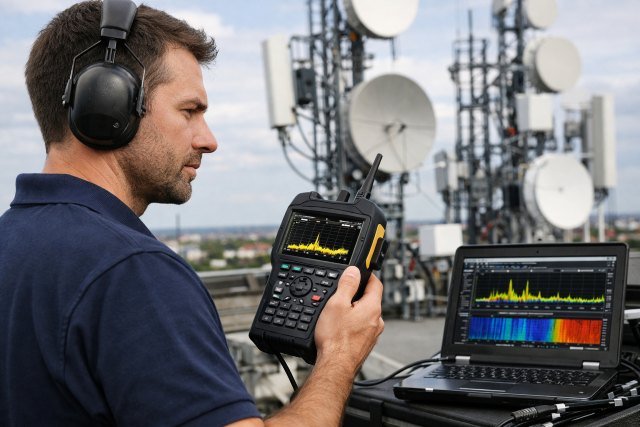
RF Scanner technology sits at the center of modern wireless visibility. From troubleshooting interference in crowded offices to monitoring mission-critical spectrum in industrial, security, telecom, and research environments, an RF Scanner helps users detect, analyze, and interpret radio frequency activity with far more precision than a basic receiver. At its core, the idea is simple: scan a range of frequencies, identify what signals are present, and measure their strength and behavior. In practice, though, modern RF monitoring has become much more advanced because wireless environments are denser, faster, and more crowded than ever. A spectrum analyzer measures the magnitude of an input signal versus frequency, while real-time analysis tools are designed to capture short, hard-to-find transient events that traditional sweep methods can miss.
- What Is an RF Scanner?
- How RF Scanner Technology Works
- Why Accurate Signal Monitoring Matters
- RF Scanner Applications in the Real World
- Key Features to Look for in an RF Scanner
- RF Scanner vs Traditional Signal Detection Tools
- Actionable Tips for Using an RF Scanner Effectively
- Common Questions About RF Scanner Technology
- Conclusion
An RF Scanner is often discussed alongside spectrum analyzers, signal analyzers, and monitoring receivers because they all serve related purposes. In practical content for readers, “RF Scanner” works well as an umbrella term for equipment or software that scans radio frequency bands to locate transmissions, monitor interference, verify signal presence, and support troubleshooting. That matters because wireless systems today depend on accurate signal monitoring more than ever, whether the application is Wi-Fi, public safety communications, satellite links, industrial telemetry, or shared-spectrum coexistence testing. NIST emphasizes that spectrum is a limited resource and that modern wireless systems increasingly depend on better measurement methods for sharing and sensing the spectrum effectively.
What Is an RF Scanner?
An RF Scanner is a tool that sweeps through selected frequency ranges and reports what radio signals exist in that part of the spectrum. Unlike a simple radio tuner that locks onto one known channel, an RF Scanner is designed to search wide or narrow bands methodically, detect signal activity, and help the user understand frequency, amplitude, and sometimes modulation-related behavior. Keysight describes a spectrum analyzer as a frequency-selective instrument used to measure and visualize signal spectrum, while Tektronix explains that the primary use is to measure the power of known and unknown signals across frequency.
That basic function makes RF scanners valuable in environments where signals are not always predictable. Interference may come and go. Unauthorized transmitters may appear briefly. Performance issues may only happen under specific load or timing conditions. A scanner gives engineers, technicians, and analysts a way to see what is happening in the air instead of guessing. Real-time spectrum analyzers are especially useful when the problem involves fleeting or bursty RF activity that a conventional swept display may not catch consistently.
How RF Scanner Technology Works
Most RF scanning tools operate by stepping or sweeping across frequencies and measuring energy at each point. The result is a visual or data-based view of signal activity over frequency. Depending on the device, the scanner may show peak levels, average levels, noise floor behavior, spurious emissions, or time-varying events. Keysight’s educational materials explain that spectrum analyzers are designed to display signal magnitude across frequency, while detector choices and instrument architecture affect how signals are captured and interpreted.
In more advanced systems, RF scanning also includes digital signal processing, recording, streaming, event triggering, and time-domain correlation. That is where modern “smart technology” really changes the game. Instead of giving users only a static snapshot, advanced RF scanners can capture intermittent emissions, compare patterns over time, and isolate events that would otherwise be invisible. Tektronix notes that real-time spectrum analysis was developed specifically to analyze dynamic RF signals effectively, which is critical when hunting intermittent interference.
Why Accurate Signal Monitoring Matters
Accurate signal monitoring matters because crowded spectrum leads directly to degraded wireless performance. When multiple services, devices, and protocols compete in the same bands, even small interference issues can reduce throughput, reliability, or safety margins. NIST defines wireless coexistence as the ability of devices and services operating in the same area to access the same RF band simultaneously without causing harmful interference to one another. That definition captures exactly why RF scanners are so important: you cannot manage coexistence well if you cannot see the spectrum clearly.
This is even more relevant now because spectrum use keeps expanding. The FCC opened 1,200 megahertz in the 6 GHz band for unlicensed use, a major policy move that supports Wi-Fi and other next-generation wireless applications. The same broader trend continues in newer FCC actions related to 6 GHz flexible use. As more devices move into valuable mid-band and higher-frequency space, the need for precise RF scanning, interference detection, and compliance monitoring only grows.
RF Scanner Applications in the Real World
One of the most common uses of an RF Scanner is wireless troubleshooting. In an enterprise office, warehouse, hospital, or campus, users may complain about dropped connections, poor roaming, or weak throughput. The root cause is not always low signal strength. It may be interference from neighboring equipment, overlapping channels, or non-Wi-Fi emitters operating nearby. An RF scanner helps identify the actual source by showing where RF energy exists and whether it matches expected system behavior. NIST’s work on coexistence and spectrum sharing reflects how measurement-driven understanding is essential when multiple systems operate close together.
RF scanners are also widely used in telecom and field engineering. Technicians use them to verify transmitter performance, inspect occupied bandwidth, detect out-of-band emissions, and locate unwanted signals. NI notes that analyzers with strong linearity and relative power accuracy are well suited to identifying the frequency and relative power of unwanted signals, which makes them valuable in real transmitter analysis.
In spectrum management and regulatory work, RF scanners support monitoring, enforcement, allocation verification, and interference investigation. The FCC’s allocation framework and national spectrum management guidance show that spectrum is structured, shared, and regulated carefully. Monitoring tools help organizations confirm that real-world usage aligns with those rules and that unexpected emissions do not disrupt licensed or protected services.
Security and surveillance environments also benefit from RF scanning. Teams may use scanners to locate unauthorized transmitters, detect hidden wireless activity, or validate that sensitive areas are free from suspicious RF emissions. In industrial and critical infrastructure settings, the same capability helps identify interference that could impact control systems, telemetry, or safety communications. NIST has published research on interference and coexistence issues in critical infrastructure, underscoring how measurement quality affects operational resilience.
Key Features to Look for in an RF Scanner
A good RF Scanner is not just about frequency coverage. One of the most important performance factors is dynamic range, which describes how well the instrument can distinguish weak signals in the presence of strong ones. NI explains that dynamic range is the span between the minimum detectable signal, represented by the noise floor, and the compression-related upper limit of the system. In plain language, better dynamic range means the scanner is more capable of revealing subtle signals without being overwhelmed.
Sensitivity is equally important. If the scanner’s noise floor is too high, weak but meaningful signals may disappear into the background. Some analyzer specifications describe very low displayed average noise levels, which helps reveal low-level transmissions. Frequency accuracy matters too, especially in environments where users need confidence that a detected signal is truly where the display says it is. Vendor technical materials from Keysight show how noise performance, amplitude accuracy, and frequency stability directly influence measurement trust.
Real-time bandwidth, scan speed, and event capture are other major considerations. If signals are short-lived, burst-based, or frequency-hopping, a slow scanner may miss them entirely. Real-time architectures improve visibility into transient events and are often the difference between solving an intermittent problem and never reproducing it. Tektronix repeatedly emphasizes this advantage in its real-time spectrum analysis resources.
RF Scanner vs Traditional Signal Detection Tools
A traditional radio receiver is built to receive and demodulate a signal. An RF Scanner is built to search, observe, and measure the RF environment. That difference is crucial. If you already know the channel and only want to listen, a receiver may be enough. If you need to understand the spectrum around you, confirm interference, track unknown activity, or analyze performance, a scanner or analyzer is the better choice. Tektronix and Keysight both frame spectrum analysis as a measurement discipline, not simply signal reception.
Compared with an oscilloscope, an RF Scanner is usually the more natural tool for frequency-domain visibility. Oscilloscopes are excellent for time-domain waveform analysis, but RF issues often become clearer when displayed across frequency. That is why signal monitoring, transmitter verification, and interference hunting are so often built around spectrum or signal analysis platforms rather than general-purpose time-domain instruments.
Actionable Tips for Using an RF Scanner Effectively
The first practical tip is to define the frequency range carefully before scanning. Wideband scans are useful for discovery, but narrower spans often give cleaner, more detailed insights when you are investigating one problem. Starting broad and then zooming in is usually more effective than scanning everything at maximum range all the time. This approach aligns with how professional analyzers are intended to visualize and isolate signal activity.
The second tip is to pay close attention to resolution settings, detector modes, and averaging behavior. A wrong detector or too much averaging can hide short bursts. Too little averaging can make the display noisy and misleading. Keysight’s detector guidance is useful here because it shows that measurement settings can materially change what the user sees.
The third tip is to interpret findings in context, not in isolation. A spike on the display is not automatically a problem. Compare it with expected allocations, nearby systems, and normal operating schedules. The FCC’s frequency allocation resources are helpful reminders that not every detected signal is abnormal; what matters is whether it belongs where it appears and whether it is causing harmful effects.
Common Questions About RF Scanner Technology
What does an RF Scanner detect?
It detects radio frequency energy within a selected band and helps identify signal presence, strength, and sometimes behavior over time. In more advanced platforms, it can also help expose transient emissions and interference patterns.
Is an RF Scanner the same as a spectrum analyzer?
Not always in strict product terminology, but in everyday usage the concepts overlap heavily. Many people use “RF Scanner” to describe tools that scan and monitor spectrum, while “spectrum analyzer” is the more formal measurement term.
Why is RF monitoring more important now than before?
Because spectrum is more crowded, wireless coexistence is harder, and unlicensed and shared-band usage keeps expanding. FCC and NIST materials both point to this broader reality.
Conclusion
An RF Scanner is no longer just a niche tool for specialists. It is smart technology for accurate signal monitoring in a world where wireless performance, coexistence, and spectrum efficiency matter more every year. Whether the goal is finding interference, validating transmitter behavior, monitoring shared bands, or improving network reliability, the value of an RF Scanner comes from one simple advantage: it helps you see the invisible. And when you can see the RF environment clearly, you can make faster, smarter, and more confident decisions about signal quality, compliance, and performance.